


Tennis Elbow &
Golfers Elbow
Tennis or Golfers Elbow can affect your grip, strength and everyday activities.
PK Physiotherapy will find the cause and provide targetted treatment to help you stay active.
Conditions we treat:
- Tennis Elbow (lateral epicondylitis)
- Golfers Elbow (medial epicondylitis)
- Tendonitis and tendinopathy
- Biceps and triceps tendon issues
- Elbow stiffness and weakness
- Post-injury rehabiltation
- Post-operative rehabilitation
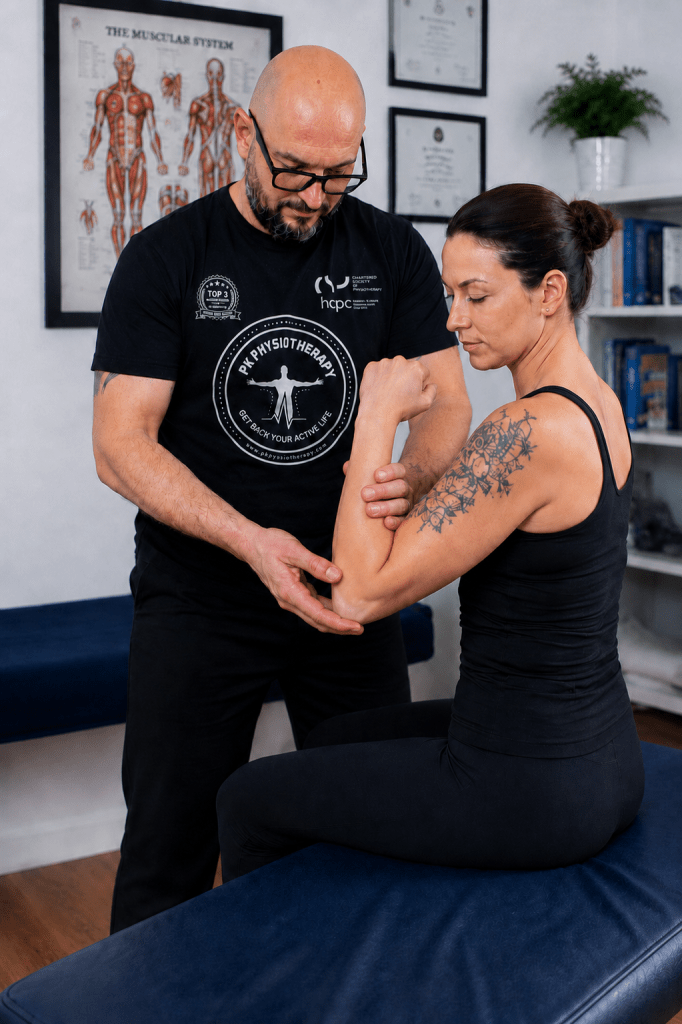
If elbow pain is affecting your work, sport, gym training or daily activities, book your assessment today at PK Physiotherapy.
CASE STUDY: Tennis Elbow
Patient: Robert
1 The Problem
Robert is a very active person who enjoys regular sport and exercise. Unfortunately, his job also involves repetitive manual tasks, placing continuous strain on both upper limbs.
Before attending PK Physiotherapy, he had seen his GP and was prescribed anti-inflammatory medication and painkillers. While these helped reduce his symptoms temporarily, the pain continued to return and was beginning to affect both his work and sporting activities.
2 Assessment Findings
Following a detailed physiotherapy assessment, I diagnosed lateral epicondylitis (Tennis Elbow).
The assessment showed tenderness around the lateral epicondyle together with weakness and overload of several forearm extensor muscles, particularly:
- Extensor Carpi Radialis Brevis (ECRB)
- Extensor Carpi Radialis Longus (ECRL)
- Extensor Digitorum
- Extensor Carpi Ulnaris (ECU)
- Supinator
There were no signs suggesting a more serious condition, making conservative physiotherapy the appropriate treatment.
3 Treatment
Robert received an individual treatment programme which included:
- Shockwave Therapy
- Interferential Therapy (IFC)
- Manual therapy to reduce muscle tension and improve tissue mobility
- Progressive strengthening exercises for the wrist extensors and forearm muscles
- Grip-strengthening and functional rehabilitation exercises
- Kinesiology Taping (KT Tape) to provide support during work and sport
- Advice on activity modification, workstation ergonomics and load management to reduce repetitive strain
4 Outcome
Robert responded very well to treatment and returned to full work duties and sporting activities within a few weeks.
Because his occupation continues to involve repetitive strain, his symptoms tend to reappear approximately once a year. However, thanks to the strengthening programme, improved understanding of his condition and early intervention, these flare-ups are now usually resolved within just one or two physiotherapy sessions, allowing him to continue both work and sport with minimal disruption.