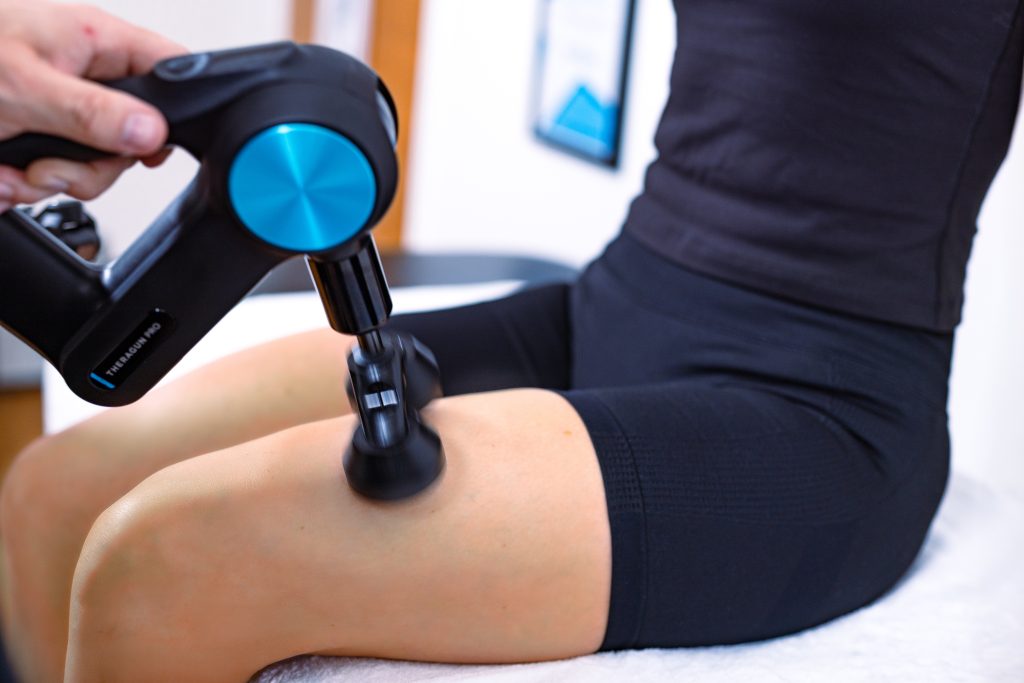
What is Percussive Therapy?
Percussive Therapy, sometimes referred to as Massage Gun Therapy, is a treatment technique that uses rapid, repetitive mechanical pulses delivered into muscles and soft tissues.
At PK Physiotherapy in Northampton, Percussive Therapy is commonly used as part of a wider rehabilitation programme to help reduce muscle tension, improve comfort and prepare tissues for exercise and movement.
Percussive Therapy is not a standalone treatment and is most effective when combined with evidence-based physiotherapy and rehabilitation.
What Conditions Can Percussive Therapy Help With?
How Does Percussive Therapy Work?
Percussive devices deliver rapid pulses into soft tissues. This mechanical stimulation may help reduce the sensation of muscle tightness, improve comfort and increase tolerance to movement.
Does Percussive Therapy Break Down Scar Tissue?
Not exactly.
A common myth is that massage guns physically break down scar tissue or adhesions. Current evidence does not support this claim. The benefits are more likely related to temporary changes in tissue sensitivity, comfort and movement rather than physically altering tissue structure.
Does Percussive Therapy Fix the Problem?
No.
Percussive Therapy can help manage symptoms and improve comfort, but long-term recovery usually depends on addressing the underlying cause through exercise rehabilitation, movement education and appropriate loading strategies.
Is Percussive Therapy Supported by Research?
Research is still evolving. Current evidence suggests that percussive therapy may help improve short-term flexibility, reduce the sensation of muscle soreness and improve comfort in some individuals.
What Will I Feel During Treatment?
Most patients describe the treatment as a deep vibrating massage sensation. Treatment intensity is adjusted according to the area being treated and individual comfort levels.
Frequently Asked Questions
Can Percussive Therapy help recovery after exercise? Many athletes use percussive therapy as part of their recovery routine.
Can Percussive Therapy replace Sports Massage? Not necessarily. Both approaches may be used independently or together depending on patient needs.
Can Percussive Therapy replace exercise? No. Exercise rehabilitation remains one of the most important components of recovery.