

Rotator Cuff Injuries
PK Physiotherapy provide specialised treatment to reduce shoulder pain, restore strength and improve function.
Benefits:
- Reduce pain
- Improve strength
- Restore mobility
- Return to activities
- Prevent re-injury
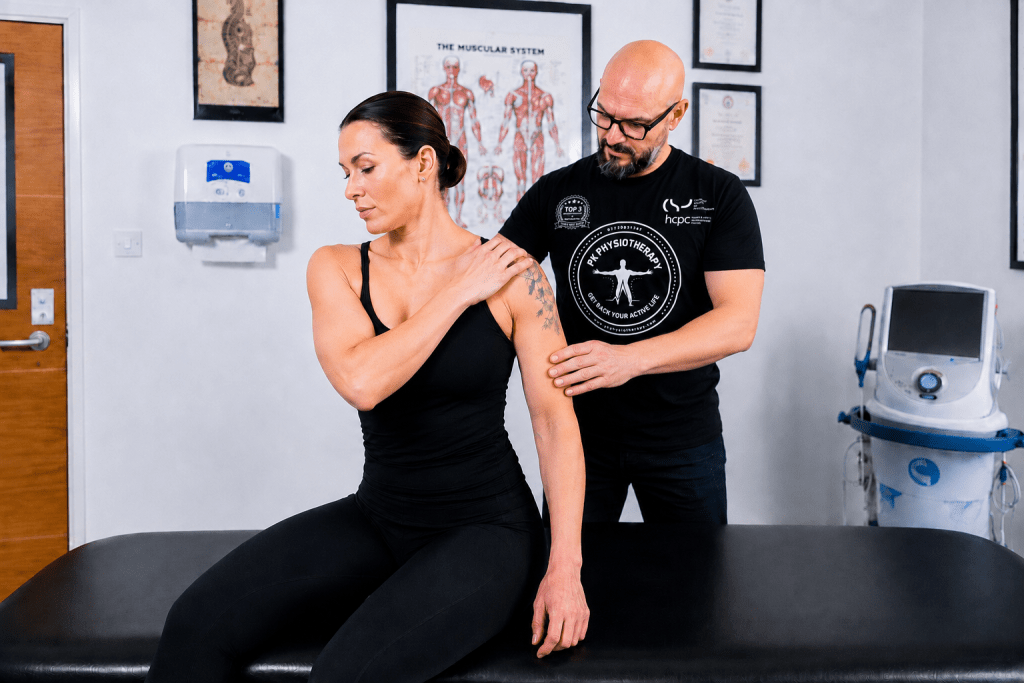
If shoulder pain or weakness is limiting your work, exercise or daily activities, book your assessment today and start your personalised recovery programme at PK Physiotherapy.
CASE STUDY: Rotator Cuff Injury
Patient: Andrew
1 The Problem
Andrew, aged 38, is a dedicated bodybuilder who trains five to six times a week. During a heavy shoulder workout, he developed a sharp pain in his right shoulder while performing an overhead press. Although he finished the session, the pain increased significantly over the following days.
Soon he found it difficult to lift his arm above shoulder height, reach behind his back and continue his normal gym routine. Sleeping on the affected shoulder also became painful, and even simple daily activities such as getting dressed were becoming increasingly uncomfortable.
2 Assessment Findings
Following a detailed physiotherapy assessment, I diagnosed a Rotator Cuff Injury, primarily affecting the supraspinatus tendon.
- Clinical examination revealed:
- Positive Empty Can (Jobe’s) Test
- Positive Hawkins-Kennedy Test
- Positive Neer Impingement Test
- Painful Arc during shoulder abduction
- Pain and weakness during resisted abduction and external rotation
- Reduced shoulder mobility
- Weakness and overload affecting the SITS muscles:
- Supraspinatus
- Infraspinatus
- Teres Minor
- Subscapularis
Secondary muscle tightness had also developed within the upper trapezius and deltoid as they were compensating for the weakened rotator cuff.
There were no clinical signs of a full-thickness tendon rupture or shoulder instability, making conservative physiotherapy the most appropriate treatment.
3 Treatment
Andrew received an individual rehabilitation programme which included:
- Shockwave Therapy
- Laser Therapy
- Manual therapy to improve shoulder mobility and reduce soft tissue tension
- Passive stretching of the shoulder complex
- Progressive strengthening exercises for the rotator cuff (SITS muscles)
- Scapular stabilisation exercises
- Functional shoulder rehabilitation
- Education regarding exercise technique, training load management and gradual return to heavy lifting
- A personalised home exercise programme
During rehabilitation, Andrew temporarily stopped heavy pressing exercises and overhead lifting, allowing the injured tendon to recover while maintaining his overall fitness through modified training.
4 Outcome
Andrew’s symptoms improved steadily throughout rehabilitation. Pain gradually reduced, shoulder movement returned to normal and strength improved with each stage of the exercise programme.
Once he regained full pain-free movement and satisfactory strength, he gradually returned to resistance training using a structured progression. Particular attention was paid to rotator cuff strengthening, scapular control and improving lifting technique to reduce unnecessary stress on the shoulder.
By the end of treatment, Andrew had returned to full gym training without pain and was able to perform overhead exercises confidently again. He now includes rotator cuff activation exercises as part of every warm-up and has remained symptom-free while continuing his bodybuilding programme.