



let’s have a look
What the evidence says about stretching, strengthening and returning to activity
PK Physiotherapy Northampton | Patient information
A pulled muscle often feels tight, so stretching it can seem like the obvious solution. But tightness after an injury does not necessarily mean that the muscle needs to be stretched.
Following a recent muscle strain, avoid forcing the painful area into a strong stretch. Restore comfortable movement and gradually rebuild the muscle’s ability to cope with load. Stretching may become useful if restricted movement is limiting recovery, but it should have a clear purpose within your rehabilitation.
This article explains the difference between stretching and strengthening, what the research can tell us, and how rehabilitation may differ for a warehouse worker with upper arm pain and a teacher returning to gym training.
The short answer
Do not repeatedly stretch a newly injured muscle simply because it feels tight. Strong or sustained stretching that reproduces the injury pain may aggravate symptoms, and there is limited evidence that isolated stretching speeds recovery from an acute strain.
Equally, a muscle strain does not automatically require complete rest. Appropriate movement and exercise can begin as the injury allows. The dose depends on the tissue involved, the severity of the injury and your response to activity. A major tear or tendon injury needs a different plan from a minor muscle strain. [1, 2, 3]
What actually happens in a muscle strain
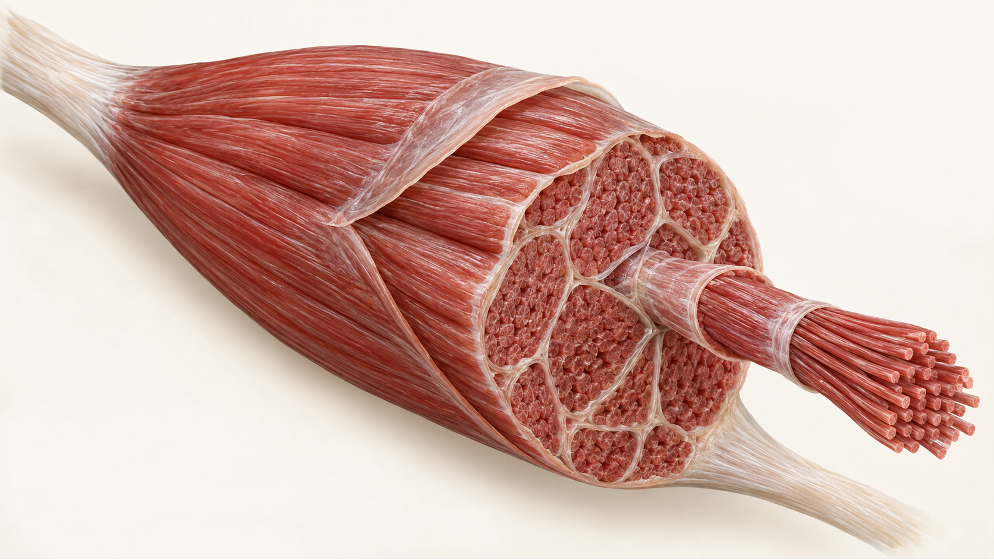
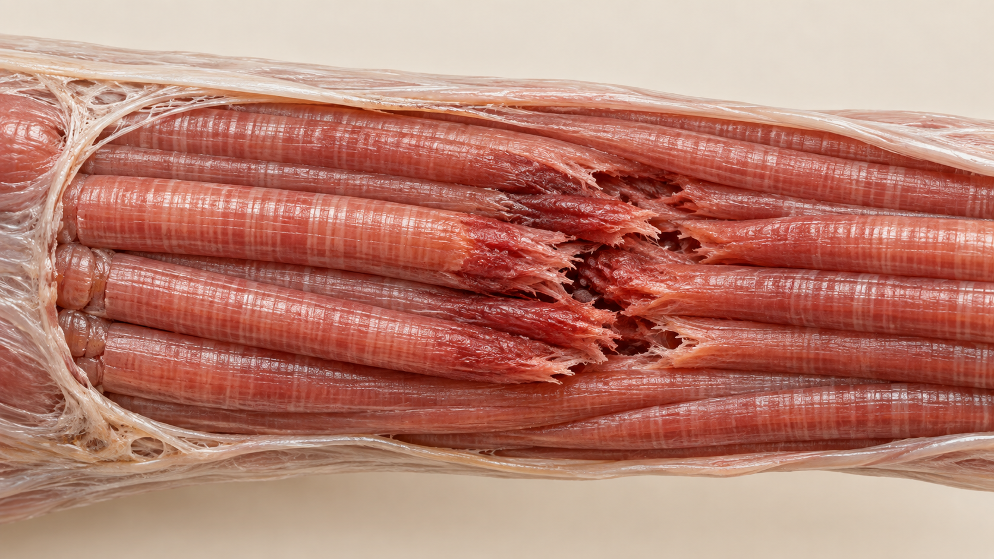
A strain is an injury to muscle tissue or the muscle and tendon unit. It can occur when the forces acting on that tissue exceed what it can tolerate at that moment. Sprinting, lifting and controlling an unexpected load are common mechanisms. The muscle may be actively producing force while it lengthens. [2]
Pain after an unfamiliar workout is not automatically a strain. General soreness that develops later differs from a sudden, localised pain during one movement. Symptoms can overlap, so the history and examination matter.
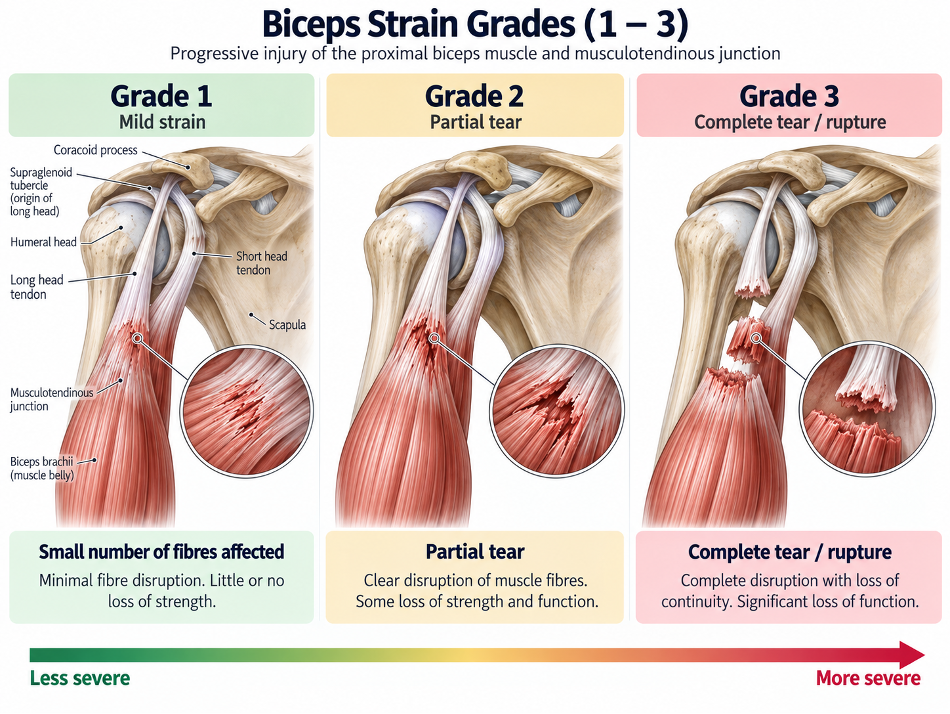
The injury may involve the muscle belly, the junction between muscle and tendon, or tendon tissue. Location matters because these injuries can differ in their management and recovery. A simple grading label cannot capture all of that information. [2, 4]
In the commonly used three grade system, Grade 1 usually describes a minor injury with relatively preserved function. Grade 2 describes a partial tear with more noticeable pain and loss of strength or movement. Grade 3 generally describes a complete rupture. Definitions differ between classification systems, so a grade should not be used on its own to predict an exact recovery date. [4]
Why the muscle can feel tight
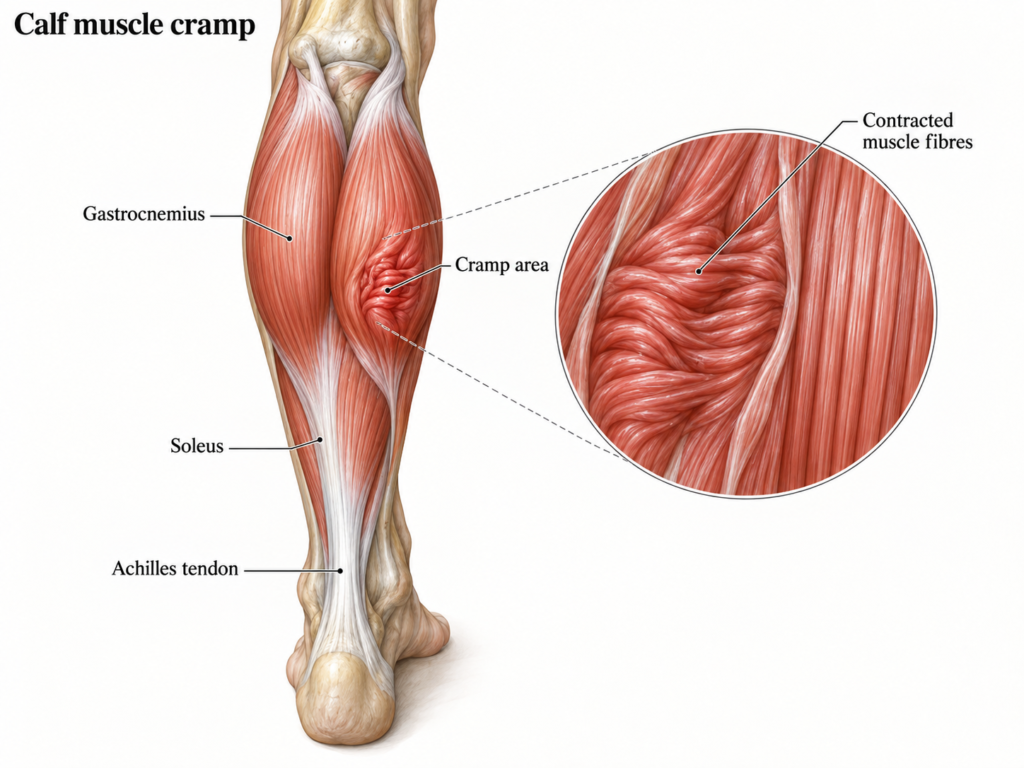
After an injury, pain, swelling and protective changes in muscle activity can make movement feel restricted. The sensation of tightness does not tell us exactly how much tissue is damaged or whether the muscle has become physically shorter.
A stretch might briefly change the sensation without addressing the reason for it. At an assessment, I consider how the injury happened, where symptoms are located, which movements reproduce them and how strength and function are affected. That gives us a better starting point than treating every feeling of tightness in the same way. [2, 5]
What to do in the first few days
NHS guidance recommends PRICE during the first two to three days: protection, rest, ice, compression and elevation. It also advises avoiding heat and massage initially, and resuming movement once pain no longer prevents it. These are broad self care recommendations, not a detailed rehabilitation programme for every muscle injury. [1]
In practice, stop the activity that caused the injury and reduce movements that clearly aggravate it. Avoid repeatedly testing the painful movement or trying to force a stretch. Protection should be proportionate to the injury; severe symptoms warrant assessment before exercise is progressed. [2, 3]
An ice pack wrapped in a towel can be used for up to 20 minutes at a time, as described by the NHS. Never place ice directly on the skin. Its use for symptom relief should not be presented as proof that it accelerates muscle healing. [1, 2]
As symptoms allow, comfortable movement and suitable muscle activation can form the beginning of rehabilitation. Modern management increasingly emphasises early activation and progressive loading rather than unnecessary prolonged immobilisation. [2]
Gentle movement is different from forcing a stretch
After a hamstring injury, moving the hip and knee through a comfortable range is different from pulling the straight leg towards the chest and holding a strong stretch. Both change muscle length, but the force, range, speed and duration differ.
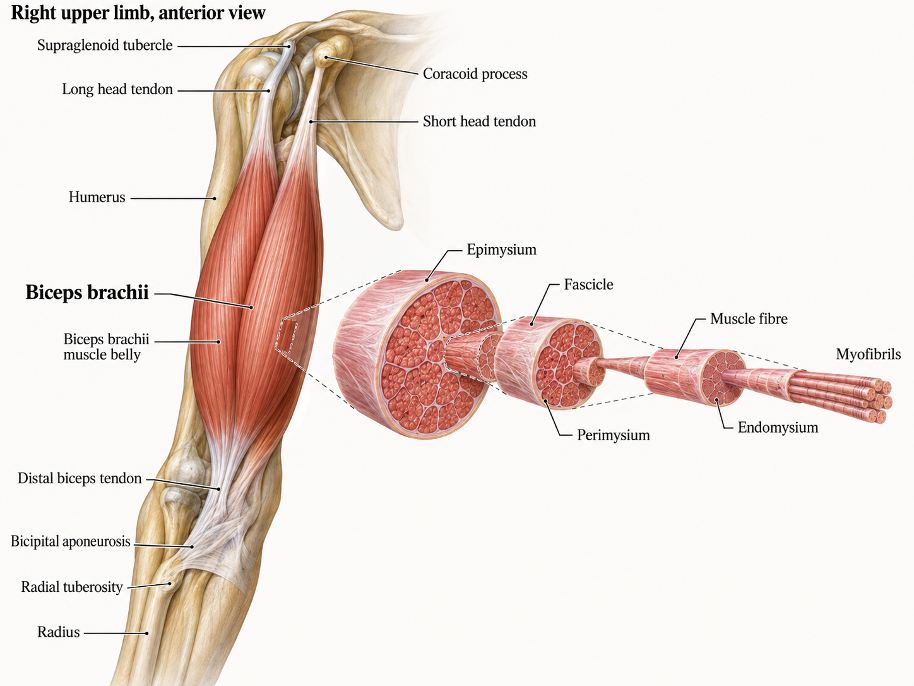
Passive stretching mainly aims to increase or maintain available movement. Strengthening requires the muscle to produce force. In eccentric exercise, the muscle produces force while the muscle and tendon unit lengthens, for example while controlling the lowering phase of a biceps curl.
Strengthening at a longer muscle length and eccentric strengthening also describe different features of an exercise. A muscle can work in a relatively lengthened position without moving, while an eccentric contraction can occur across different parts of its range.
These distinctions matter when interpreting research. A study of controlled lengthening exercises does not establish whether forceful passive stretching is helpful immediately after injury. [5, 6]
What the research supports
A 2025 international stretching consensus concluded that stretching can improve range of motion and reduce measured muscle stiffness. It did not support stretching as a complete injury prevention strategy or as a reliable way to improve immediate recovery after exercise. These findings concern stretching more broadly and should not be mistaken for a treatment protocol for a torn muscle. [7]
A 2022 systematic review included 32 trials and found that eccentric exercise can improve flexibility in adults. That suggests flexibility and strength do not always need separate interventions. It does not prove that every fresh muscle injury should receive eccentric exercise at the same intensity or from the same day. [8]
More directly relevant to injury rehabilitation, a review of nine randomised trials in athletes with acute hamstring injuries supported loading programmes, but could not establish firm conclusions about stretching because the evidence was limited. [9]
Taken together, the evidence supports a cautious message: stretching can be useful for movement goals, but stretching alone has not been established as a reliable way to speed recovery from an acute muscle strain.
Hamstring rehabilitation and the timing of exercise
The 2023 London International Consensus recommends individualised hamstring rehabilitation. Early rehabilitation should avoid high strain loads and rapid loading, while progression should reflect symptoms and capacity. The experts did not agree on every flexibility or strength benchmark. This is expert consensus informed by evidence, rather than proof of one ideal programme. [3]
In a randomised trial, Vermeulen and colleagues studied 90 male athletes with MRI confirmed acute hamstring injuries. Introducing lengthening exercises earlier did not produce a statistically significant improvement in return to sport or reinjury outcomes compared with delayed introduction. The exercises were eccentric strengthening exercises within a rehabilitation programme, not isolated passive stretches. [6]
A lack of statistical significance does not prove that the approaches are identical. Nor can findings in these athletes be applied automatically to every patient, muscle or tendon injury.
It is also too restrictive to say that eccentric exercise belongs only at the end of rehabilitation. Research in selected patients has introduced it earlier using exercise specific progression criteria. This requires an appropriate assessment and dose, rather than an instruction to start heavy exercises immediately after any strain. [5, 10]
How rehabilitation progresses
Early rehabilitation aims to maintain useful movement while avoiding excessive stress. Depending on the injury, this may include gentle active movement and a low effort muscle contraction without joint movement, known as an isometric exercise.
As tolerance improves, the programme can expand the movement range and increase resistance or repetitions. Exercises may include different types of contraction. There is no universal requirement to complete a fixed number of days of isometric exercise before any other exercise is allowed.
Later rehabilitation prepares you for the tasks you need to perform. For a warehouse worker, that includes repeated lifting and carrying. For someone returning to running, it includes progressively faster running. For a gym user, it includes building back towards the required training movements and loads. These stages overlap and are adjusted rather than followed as a rigid timetable. [5]
Progress should consider the response during exercise, afterwards and the following day. If a session leaves you substantially more painful, weaker or less able to move, the amount of exercise may need to be reduced and the injury reassessed. This is a practical monitoring approach, not a precise test of tissue healing.
Some supervised rehabilitation allows mild, tolerable symptoms. Sharp pain, worsening function or a new injury sensation should not be pushed through. The acceptable response depends on the activity and diagnosis. [3, 5]
You can read more about Specific Personalised Exercise Programmes at PK Physiotherapy.
When stretching may be useful
Stretching can be considered when a remaining movement restriction affects an important task and a gentle stretch is tolerated. Start with a comfortable range and reassess how the area responds. There is no evidence based rule that everybody should start on day three, seven or fourteen.
For example, a person may regain enough movement through active exercise and strengthening. Someone else may benefit from additional gentle stretching. The decision should follow the assessment and the task they are working towards. Stretching that repeatedly brings back the original injury pain is a reason to review the approach. [3, 5, 7]
There is also no established universal hold time or repetition count for stretching a healing muscle. A general flexibility routine for a healthy person should not automatically become a prescription for a recent tear.
Case Study 1: Biceps Strain
The following two case studies are based on patients treated at PK Physiotherapy. Identifying details have been removed or altered to protect patient confidentiality. They are included to illustrate clinical reasoning and rehabilitation principles and should not be interpreted as guaranteed treatment outcomes.
A warehouse operative develops sudden pain at the front of his upper arm while picking boxes. One box shifts unexpectedly and pulls his elbow towards a straight position as he tries to control it.
His arm feels tight, so he repeatedly straightens the elbow and draws the arm backwards to stretch it. This reproduces the pain.
The first priority is to determine what has been injured. This mechanism can affect the biceps muscle, but it can also rupture the distal biceps tendon near the elbow. Being able to bend the elbow, or having no obvious deformity, does not reliably exclude a tendon tear. Other muscles can preserve elbow movement even when the distal biceps tendon has ruptured. [11]
A clinician would assess the location of pain, tendon integrity, elbow flexion and the ability to turn the palm upwards against resistance. Suspected tendon rupture requires prompt medical assessment rather than a trial of stretching. Imaging may be needed if the diagnosis is uncertain. [11]
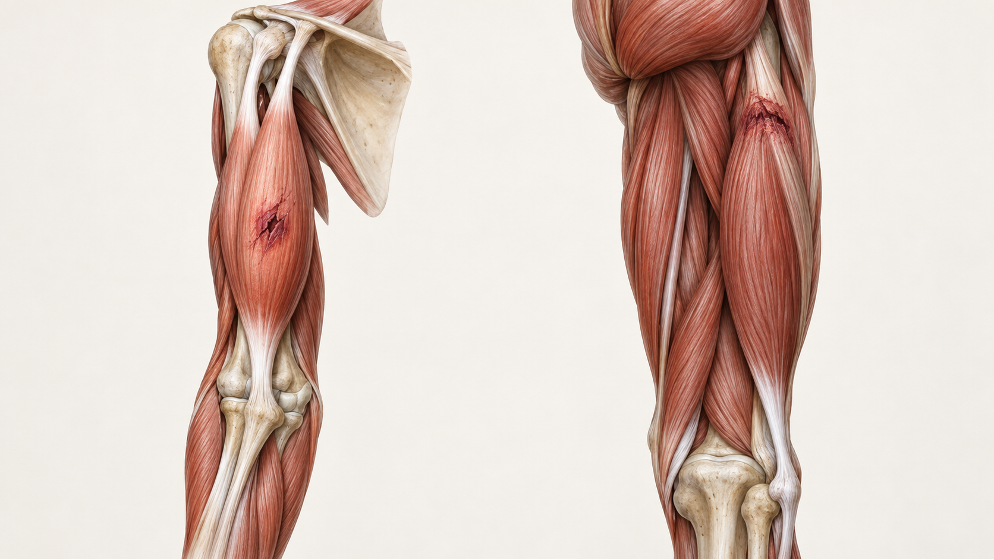
If assessment supports an uncomplicated muscle strain, an individual programme might begin with comfortable movement and controlled, light muscle activation. Work adjustments could temporarily reduce heavy or repetitive lifting, long reaches and handling unpredictable loads.
Progression might include elbow flexion, forearm rotation, controlled lowering of a weight, and then lifting and carrying tasks. Exercise volume would gradually increase to reflect the demands of a shift. Work adjustments should be agreed with the employer and reviewed as function improves.
One comfortable biceps curl would not establish readiness for unrestricted warehouse picking. The aim would be to tolerate repeated handling at suitable loads without a substantial deterioration during the shift or afterwards.
This is an application of rehabilitation principles to a work task. It is not a biceps specific protocol proven by hamstring research.
Case Study 2: a Gym Related Hamstring Strain
A secondary school teacher feels sudden pain at the back of the thigh during the lowering phase of a Romanian deadlift. He stops training. Walking is possible, but longer strides, bending forwards and hamstring stretching reproduce the pain.
Assessment would explore the location and mechanism of injury, walking, strength and movement. Pain high near the buttock, extensive bruising or marked weakness would raise concern about a more substantial injury, including a proximal tendon injury. Back or nerve related pain would also be considered. [5]
If the findings support an uncomplicated hamstring strain, rehabilitation could begin with tolerable daily movement and selected muscle loading. His work demands would also matter: stairs, prolonged standing and moving between classrooms might temporarily need adjustment.
The exercise programme could progress through suitable bridge or curl variations and hip hinge exercises. A Romanian deadlift might later be reintroduced with a reduced load and a shorter range, then progressed according to the response. It does not have to be permanently avoided because it was the movement during which the injury occurred.
However, the original injury does not prove that the hamstring was weak or that the lifting technique was wrong. The load, fatigue, recent training and unexpected events may all be relevant.
The goal would be a gradual return to the intended training volume and resistance, rather than using one comfortable repetition or a toe touch as evidence of full recovery.
Information about Sports Injury Treatment in Northampton explains how an assessment can guide this process.
Feeling better is not the only return criterion
Pain can settle while strength, endurance or confidence remain below what the activity demands. A comfortable walk does not demonstrate readiness to sprint, just as pain free elbow movement does not demonstrate readiness for repeated heavy lifting.
A return plan should consider the relevant tasks, repeated effort and the response to increasing workload. A gradual return may start before all rehabilitation is complete, with restrictions and progression appropriate to the diagnosis. No single test guarantees that another injury will not occur. [3, 5]
When to seek medical help
Contact NHS 111 or an urgent treatment centre if pain is severe or worsening, swelling or bruising is substantial, or you cannot use the limb or walk normally. Seek review if symptoms are not improving with self care. [1]
After an injury, altered limb shape, numbness or a cold, blue or grey limb needs emergency assessment. Do not assume these symptoms are a simple muscle strain. [1]
A sudden upper arm or elbow injury with a pop and weakness when turning the palm upwards warrants prompt assessment for a biceps tendon tear. Do not wait for bruising to appear before seeking help. [11]
Many uncomplicated muscle strains can be assessed without a scan. Ultrasound or MRI may help when a significant muscle or tendon tear is suspected, the diagnosis is uncertain or recovery is not following the expected course. Imaging supports the examination; it does not provide a reliable return date on its own. [2, 4, 5]
Common questions
Will massage help a fresh strain?
Avoid deep massage directly over a fresh injury. NHS guidance advises avoiding massage in the first couple of days. Later, selected soft tissue treatment may help symptoms, but it should not be presented as a substitute for rebuilding strength and function. [1, 2]
Can stretching prevent another injury?
Stretching can improve flexibility, but it is not a complete prevention programme. Exercise preparation should also consider strength, workload and the demands of the activity. More flexibility is not automatically better for every person or sport. [7]
How long will recovery take?
Recovery varies with the tissue involved, injury severity and the activity you are returning to. A mild strain and a tendon rupture should not be given the same timeline. Progress checks provide a more useful guide than promising that everyone will recover in a set number of weeks. [2, 4]
Physiotherapy assessment at PK Physiotherapy Northampton
At PK Physiotherapy, the starting point is an individual assessment of your symptoms, movement, strength and the activities you need to return to. Where a more serious injury is suspected, referral for further assessment may be appropriate.
Rehabilitation may include advice, temporary activity modification and progressive exercise. Stretching can be included when it serves a useful purpose, rather than prescribed automatically because the injured area feels tight.
Read about the Initial Physiotherapy Assessment or book an assessment at PK Physiotherapy.
The practical message is simple: avoid forcing a painful fresh strain, keep suitable movement in your recovery plan, and gradually rebuild what the muscle needs to do for your work, gym training or sport.
Get back your active life.
Medical evidence and further reading
1. NHS. Sprains and strains. Patient guidance. Reviewed 23 April 2024.
2. Edouard P and colleagues. Traumatic muscle injury. Nature Reviews Disease Primers. 2023. doi:10.1038/s41572-023-00469-8.
3. Paton BM, Read P, van Dyk N and colleagues. London International Consensus and Delphi study on hamstring injuries part 3: rehabilitation, running and return to sport. British Journal of Sports Medicine. 2023. doi:10.1136/bjsports-2021-105384.
4. Paton BM and colleagues. London International Consensus and Delphi study on hamstring injuries part 1: classification. British Journal of Sports Medicine. 2023. doi:10.1136/bjsports-2021-105371.
5. Hickey JT, Opar DA, Weiss LJ, Heiderscheit BC. Hamstring Strain Injury Rehabilitation. Journal of Athletic Training. 2022. doi:10.4085/1062-6050-0707.20.
6. Vermeulen R and colleagues. Early versus delayed lengthening exercises for acute hamstring injury in male athletes: a randomised controlled clinical trial. British Journal of Sports Medicine. 2022. doi:10.1136/bjsports-2020-103405.
7. Warneke K and colleagues. Practical recommendations on stretching exercise: A Delphi consensus statement of international research experts. Journal of Sport and Health Science. 2025. doi:10.1016/j.jshs.2025.101067.
8. Diong J, Carden PC, O’Sullivan K, Sherrington C, Reed DS. Eccentric exercise improves joint flexibility in adults: A systematic review update and meta analysis. Musculoskeletal Science and Practice. 2022. doi:10.1016/j.msksp.2022.102556.
9. Jankaew A, Chen JC, Chamnongkich S, Lin CF. Therapeutic Exercises and Modalities in Athletes With Acute Hamstring Injuries. Systematic review and meta analysis. Sports Health. 2023. doi:10.1177/19417381221118085.
10. Hickey JT and colleagues. Early introduction of high intensity eccentric loading into hamstring strain injury rehabilitation. Journal of Science and Medicine in Sport. 2022. doi:10.1016/j.jsams.2022.06.002.
11. American Academy of Orthopaedic Surgeons. Biceps Tendon Tear at the Elbow. OrthoInfo patient guidance.
This article provides general education and does not replace an individual assessment. The case studies are based on anonymised patients treated at PK Physiotherapy. Identifying details have been removed or altered to protect patient confidentiality. The AI generated images are illustrative and do not document actual patients.
Useful PK Physiotherapy Links
Initial Physiotherapy Assessment
Specific Personalised Exercise Programmes