


When Shoulder Pain Starts Affecting Everyday Life
Shoulder pain can be surprisingly disruptive.
You may still be able to use your arm reasonably well during the day, yet wake at night because you rolled onto the painful side. Reaching into a cupboard becomes uncomfortable. Putting on a jacket is awkward. Lifting a shopping bag away from your body suddenly feels much harder than it should.
For some people, the problem begins after a fall, a heavy lift or an injury at the gym. For others, there is no obvious moment when anything went wrong. The shoulder simply becomes increasingly painful over several weeks or months.
Then comes the ultrasound or MRI report:
Rotator cuff tendinopathy.
Partial thickness tear.
Or perhaps the words that worry patients most:
Full thickness rotator cuff tear.
It is understandable to assume that a torn tendon must be surgically repaired. In reality, shoulder problems are rarely that simple.
A scan is important when imaging is clinically indicated, but it is only one part of the picture. The way the problem started, your age, strength, movement, level of pain, loss of function, occupation, sporting demands and what you want to return to are all important.
Most importantly, a rotator cuff abnormality on a scan and a painful shoulder are not automatically the same thing.
Modern research has repeatedly identified rotator cuff abnormalities in people who have no shoulder symptoms at all, and these findings become increasingly common with age.
So if your scan says tear, the first question should not automatically be:
When do I need surgery?
A much more useful starting point is:
What is actually happening to my shoulder, how well is it functioning and what can we realistically improve?
What Exactly Is the Rotator Cuff?
The rotator cuff is not one muscle.
It is a group of four muscles and their tendons that work together around the shoulder:
• supraspinatus
• infraspinatus
• teres minor
• subscapularis
Together, they help stabilise the head of the humerus within the shoulder joint while allowing the arm to move.
This system is working when you reach overhead, put your hand behind your back, lift a kettle, throw a ball, swim, work with your arms above shoulder height or perform an overhead press in the gym.
The shoulder has an enormous range of movement. That mobility is one of its greatest advantages, but it also means that effective muscular control is essential.
When the rotator cuff becomes painful, overloaded, weakened or structurally damaged, activities that previously required no thought can suddenly become difficult.
More information about the condition is available on the PK Physiotherapy Rotator Cuff Injuries page.
Not Every Rotator Cuff Problem Is a Tear
This is where terminology can become confusing.
Patients often use the terms rotator cuff injury, tendinitis and tear interchangeably, but they do not necessarily describe the same problem.
Rotator Cuff Tendinopathy
Tendinopathy describes a painful tendon related condition involving changes in the tendon and its response to load.
Symptoms often develop gradually rather than following one dramatic injury.
You might notice discomfort during overhead activity, gym exercises, repetitive work or reaching away from the body. Night pain can also occur.
Partial Thickness Tear
A partial thickness tear means that part of the tendon thickness has been disrupted, but the tendon has not torn completely through.
The size and location of the tear matter, but so does something that cannot be measured simply by looking at the scan:
How well does the shoulder actually work?
A patient can have a partial tear and surprisingly good strength and function.
Another person with apparently less dramatic imaging findings can be significantly limited by pain.
Full Thickness Tear
A full thickness tear extends through the complete thickness of the tendon.
Even here, the clinical picture varies.
A gradually developing degenerative tear in an older adult who retains useful strength and movement is very different from a sudden traumatic tear in an active person who falls, feels immediate pain and suddenly cannot lift the arm properly.
Both may be called full thickness tears.
They are not necessarily the same clinical problem and should not automatically follow the same treatment pathway.
Why Your MRI Can Look Worse Than Your Shoulder Feels
This is one of the most important things I explain to patients with rotator cuff problems.
Imaging abnormalities are not unusual in shoulders that do not hurt.
A systematic review of 30 studies involving more than 6,000 shoulders found that rotator cuff abnormalities became substantially more common with increasing age, including among people without symptoms.
A more recent 2025 systematic review also found rotator cuff abnormalities on ultrasound and MRI in asymptomatic adults, although the authors noted considerable variation between studies and low to very low certainty for prevalence estimates.
This does not mean MRI or ultrasound is useless.
Far from it.
Imaging can be extremely valuable when used for the right patient and the right clinical question.
What it means is that we need to interpret the scan rather than simply react to it.
If a 60 year old patient has shoulder pain and an MRI demonstrates a small degenerative supraspinatus tear, we still need to determine whether that finding explains the symptoms.
How did the pain begin?
Was there trauma?
Is there genuine weakness or is movement limited primarily by pain?
What is the active range compared with passive movement?
Can the patient work?
Can they sleep?
What happens when the rotator cuff is loaded?
Are symptoms coming from the shoulder at all, or could the cervical spine or another structure be contributing?
The scan provides anatomy.
The clinical assessment provides context.
Do I Need an MRI?
Not necessarily.
For many patients presenting with shoulder pain, a good history and clinical examination are the appropriate starting point.
The 2025 rotator cuff tendinopathy clinical practice guideline covers clinical assessment, nonsurgical management and rehabilitation, including tendinopathy with or without calcification and partial thickness tears.
Imaging becomes more relevant when the result is likely to influence management, when significant structural injury is suspected, when symptoms are not behaving as expected or when surgical assessment is being considered.
If you have never had the shoulder professionally assessed, an Initial Physiotherapy Assessment at PK Physiotherapy can establish movement, strength, function and the likely source of symptoms before deciding what should happen next.
What Can Physiotherapy Actually Change?
This is a question worth answering properly.
Physiotherapy cannot promise to make every structural abnormality disappear from an MRI.
That is not the objective.
The aim is to improve the shoulder that belongs to the person, not to produce a prettier scan.
A rehabilitation programme can work on:
• pain and movement tolerance
• shoulder range of movement
• rotator cuff strength
• scapular control
• endurance
• load tolerance
• coordination of shoulder movement
• confidence using the arm
• work specific function
• gym or sport specific function
The programme should then progressively expose the shoulder to the activities it needs to tolerate.
For one patient, that may mean reaching comfortably into a kitchen cupboard.
For another, it may mean lifting equipment at work.
For a swimmer, tennis player or bodybuilder, the demands are considerably greater.
The exercise programme should reflect those differences.
This is why I prefer Specific Personalised Exercise Programmes rather than giving every patient with shoulder pain the same three exercises.
Exercise Is Important, but More Is Not Always Better
There is sometimes a tendency to think that if three exercises are good, ten must be better.
That is not necessarily true.
The GRASP trial, a large UK randomised controlled trial involving adults with rotator cuff disorders, compared a progressive exercise programme delivered over several physiotherapy sessions with a single best practice advice session supported by a home exercise programme.
Over 12 months, the more intensive progressive exercise programme did not produce superior outcomes compared with best practice advice.
That is an important finding.
It does not mean exercise is pointless or that physiotherapy consists of giving somebody a leaflet and sending them home.
It tells us that successful rehabilitation is not simply about accumulating appointments or exercises.
Good education, appropriate exercise selection, progression, self management and patient participation matter.
Some patients need relatively little supervision.
Others need considerably more because of weakness, fear of movement, demanding work or sporting goals, postoperative restrictions, difficulty progressing exercises or a more complex clinical presentation.
The treatment needs to fit the patient.
When Conservative Treatment Is Worth Trying
For many non traumatic rotator cuff problems, conservative management is an appropriate starting point.
This may include education, activity modification, appropriate exercise and progressive strengthening.
AAOS updated its evidence based Clinical Practice Guideline for rotator cuff injuries in 2025, while the 2025 JOSPT guideline specifically addresses nonsurgical care and rehabilitation for rotator cuff tendinopathy, including partial thickness tears.
In practice, I am particularly interested in whether the patient is beginning to regain:
• movement
• strength
• tolerance to load
• sleep quality
• confidence
• ability to work
• ability to perform everyday tasks
• ability to return progressively to exercise
Improvement is not always perfectly linear.
A shoulder can have good days and bad days during rehabilitation, particularly as loading increases.
What matters is the overall direction of recovery.
When I Would Want a Surgical Opinion
Physiotherapy is extremely useful, but good physiotherapy also means recognising when physiotherapy alone may not be the right answer.
A surgical or specialist medical opinion becomes more important when the clinical presentation suggests significant structural injury or when appropriate conservative management is not achieving the required result.
I would be particularly cautious following a significant traumatic event associated with a sudden major loss of shoulder strength or function.
Other reasons for further investigation or specialist opinion can include substantial functional weakness, a suspected acute full thickness tear in an active patient, associated injuries, progressive deterioration or persistent disability despite appropriate rehabilitation.
The 2025 AAOS guideline covers both non operative and operative management of adult rotator cuff injuries and emphasises evidence based decision making across the treatment pathway.
The important point is that referral to a surgeon is not a failure of physiotherapy.
Sometimes it is exactly what responsible physiotherapy should lead to.
What About Cortisone Injections?
Corticosteroid injections can reduce shoulder pain for some patients, but expectations need to be realistic.
In the GRASP trial, corticosteroid injection was associated with a modest improvement in shoulder pain and function at eight weeks, but there was no evidence of benefit over 12 months.
So an injection may provide short term symptom relief for some patients.
It should not be confused with rebuilding shoulder strength or restoring the capacity of the tendon and surrounding muscles to tolerate load.
If reduced pain creates an opportunity to move better and engage with rehabilitation, that can be useful.
But pain relief and rehabilitation are not the same thing.
Where Does Shockwave Therapy Fit In?
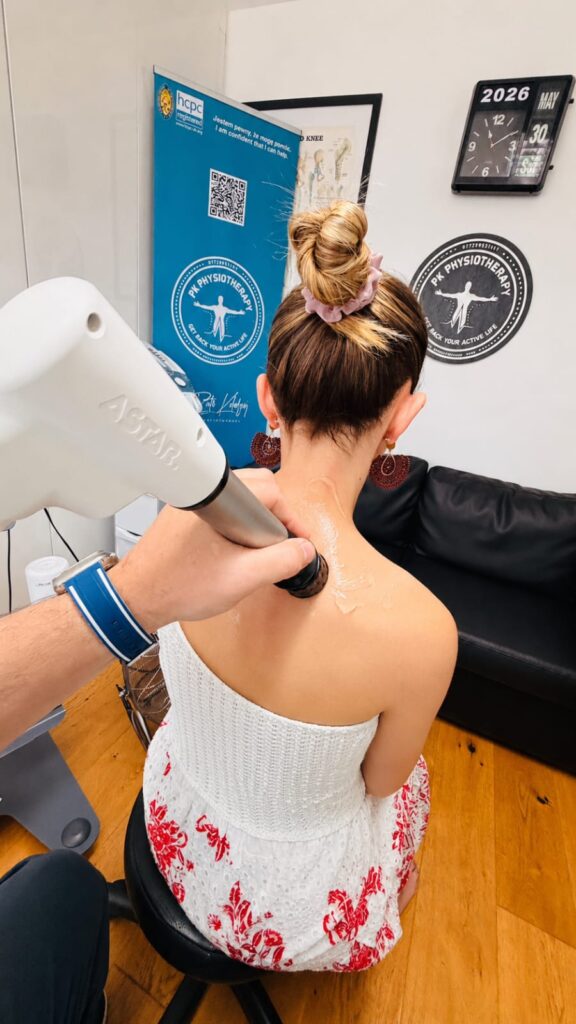
Shockwave therapy deserves a separate discussion because I use it regularly in my clinic, but it is not appropriate for every painful shoulder.
Its role is much more specific.
The 2025 clinical practice guideline for rotator cuff tendinopathy includes recommendations covering tendinopathy with and without calcification.
In clinical practice, shockwave may be considered particularly in selected chronic tendon presentations and calcific rotator cuff tendinopathy.
What it should not become is a treatment automatically applied to every shoulder simply because the patient has pain.
And shockwave cannot reconnect a completely ruptured tendon.
At PK Physiotherapy, I use it only when the clinical presentation makes it appropriate and normally as one component of a wider rehabilitation strategy.
You can read more about how and when I use it in Shockwave Therapy at PK Physiotherapy Northampton: Does It Really Work?.
Is Manual Treatment Still Useful?
Exercise and progressive loading are central to rehabilitation, but that does not mean every other physiotherapy technique suddenly has no value.
A painful and guarded shoulder may also have restricted movement, muscle tension and difficulty tolerating exercise.
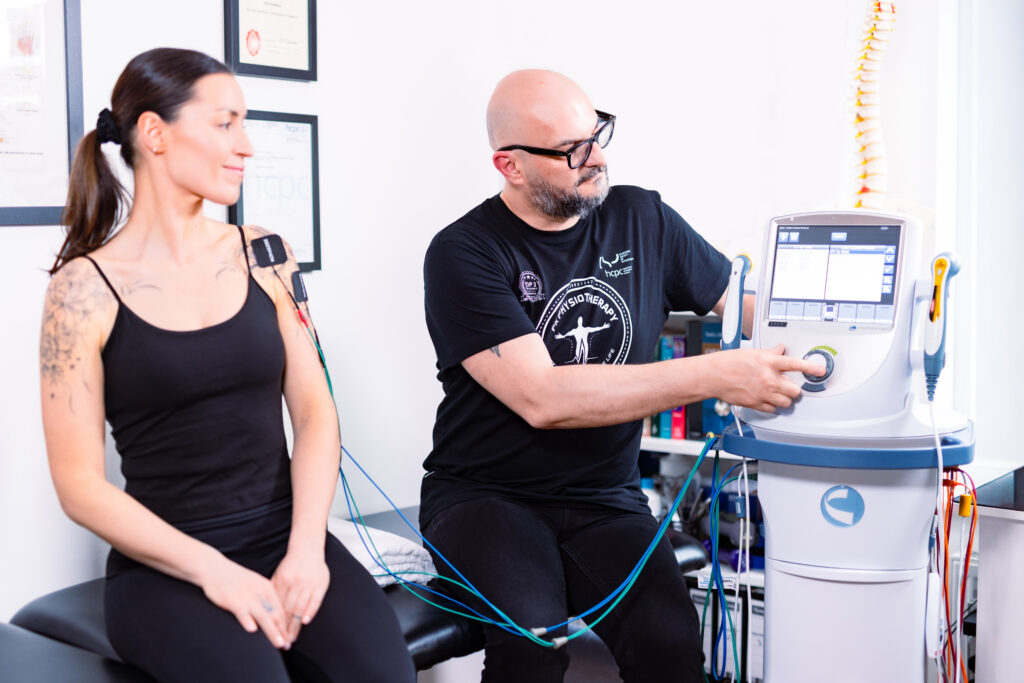
Depending on what I find during assessment, I may incorporate Joint Mobilisation and Manipulation, Sports Massage, Electrotherapy using IFC and TENS or Kinesiology Taping.
The purpose of these treatments is not to pretend that a machine, massage or piece of tape can repair a torn tendon.
Their value, when appropriate, is to support the rehabilitation process by helping manage symptoms, movement or exercise tolerance.
The active rehabilitation programme remains central.
What If Surgery Is Necessary?
If a rotator cuff tear requires surgical repair, the operation is only one part of recovery.
The repaired tendon needs time to heal, and rehabilitation has to respect that biology.
The early phase can involve protection of the repair, often with a sling according to the surgeon’s protocol, together with carefully controlled progression of movement.
Later, rehabilitation gradually shifts towards active movement, strength, endurance and functional loading.
Eventually the programme needs to prepare the shoulder for the individual’s real life demands.
Returning an office worker to comfortable computer use is very different from preparing a builder for repeated overhead work or an athlete for competitive sport.
Rehabilitation following surgery should therefore be progressive and coordinated with the surgical protocol.
More information is available on the PK Physiotherapy Post Surgical Rehabilitation page.
Three Different Shoulders, Three Different Decisions
Case Study 1: The Painful Shoulder That Did Not Need Surgery
A 46 year old recreational gym user developed gradually increasing shoulder pain over several months.
There was no single injury.
Bench pressing remained relatively comfortable, but overhead pressing and lateral raises became painful. He also started waking when sleeping on the affected side.
His main concern was that he had torn something and continuing to train would make the damage worse.
Assessment showed painful but relatively well preserved shoulder movement, reduced tolerance to resisted abduction and external rotation and weakness compared with the opposite side. There was no history or clinical presentation suggesting an acute major tendon rupture.
Instead of stopping all training, we modified the exercises that were provoking symptoms and started a progressive strengthening programme.
The early aim was not to chase heavy weights. It was to make the shoulder comfortable enough to tolerate consistent loading.
As symptoms improved, resistance increased and gym exercises were gradually reintroduced.
He returned to his normal training without requiring surgical assessment.
The key to this case was not finding a treatment that instantly removed pain.
It was giving the shoulder the right amount of load at the right time.
Case Study 2: The Scan Looked Frightening, but the Shoulder Functioned Better Than Expected
A 61 year old patient attended after an ultrasound reported rotator cuff tendinopathy with a partial supraspinatus tear.
The word tear had understandably caused considerable anxiety.
He had already started avoiding lifting with the arm because he believed normal use might make the tendon rupture completely.
Interestingly, his clinical examination was much more encouraging than the wording of the scan suggested.
Movement was reasonably well preserved. Strength was reduced but functional. There had been no traumatic injury and no sudden loss of arm function.
We discussed what the scan did and did not tell us.
Rehabilitation concentrated on restoring confidence, gradually increasing rotator cuff and scapular loading and returning to normal daily activity.
As strength and load tolerance improved, the patient became progressively less protective of the shoulder.
The tear did not need to disappear from the scan for the patient to feel and function better.
That distinction matters.
Successful rehabilitation is measured by the person, not by whether every age related structural change disappears from an image.
Case Study 3: When Physiotherapy Alone Was Not the Right Answer
A physically active patient injured his shoulder during a fall.
Unlike the previous two cases, the change was immediate.
He developed marked weakness and struggled to actively elevate the arm despite having considerably more passive movement available.
This presentation concerned me much more than a gradually developing painful shoulder.
Physiotherapy assessment in this situation was not about beginning weeks of routine treatment and hoping for improvement.
The sudden traumatic mechanism and substantial loss of function warranted further investigation and an orthopaedic opinion.
Imaging confirmed a significant rotator cuff tear and surgical management was recommended.
Physiotherapy then became important again during postoperative rehabilitation.
The lesson from this case is equally important:
Conservative treatment is not always the correct treatment.
Experience is not only knowing what to treat.
Sometimes it is knowing when not to continue treating without further investigation.
My Clinical Perspective After More Than 30 Years in Physiotherapy
After more than three decades of treating musculoskeletal problems, shoulder pain remains one of those conditions that constantly reminds me why clinical assessment matters.
I have seen patients arrive extremely worried because their scan contains the word tear, yet their shoulder remains strong and functional.
I have also seen patients with relatively little pain whose sudden loss of strength after trauma immediately makes me much more concerned.
That is why I never make a treatment decision from one sentence in an MRI or ultrasound report.
I look at the whole story.
How did it start?
Was there trauma?
What movements are difficult?
Is the problem pain, weakness, stiffness or a combination of all three?
What can the patient still do?
What have they stopped doing because they are frightened of causing damage?
And finally:
What does this particular person need their shoulder to do?
A 70 year old who wants to sleep comfortably and play with their grandchildren does not necessarily require the same shoulder capacity as a 30 year old competitive swimmer.
A bodybuilder who wants to return to heavy overhead pressing creates different demands again.
This is also why I do not believe in treating every rotator cuff problem with exactly the same protocol.
Exercise is extremely important, but it needs to be appropriate.
Manual therapy may help one patient but add very little for another.
Shockwave therapy may be useful for a carefully selected chronic or calcific tendon problem but completely inappropriate for an acute rupture.
Sometimes the correct decision is rehabilitation.
Sometimes it is further imaging.
Sometimes it is referral to an orthopaedic surgeon.
The skill is not in using as many treatments as possible.
It is in choosing the right treatment, for the right patient, at the right stage of recovery.
Questions Patients Often Ask Me
Can a rotator cuff tear heal by itself?
That depends on what we mean by heal.
Some structural tears may remain visible on imaging. However, pain, strength and function can improve substantially despite persistent structural abnormalities.
A successful outcome does not necessarily require a completely normal MRI.
If my scan shows a tear, will exercise make it worse?
Not automatically.
Appropriately selected and progressively loaded exercise is an important part of nonsurgical management for many rotator cuff conditions.
The programme should reflect the type of injury, symptoms and functional requirements rather than simply forcing through pain.
Should I stop using my painful arm?
Usually, complete avoidance is not the objective.
Temporary modification of aggravating activities may be sensible, particularly when symptoms are highly irritable, but prolonged unnecessary avoidance can contribute to weakness and loss of confidence.
The appropriate amount of activity depends on the diagnosis.
Is night pain a sign that I need surgery?
No.
Night pain is common in rotator cuff related shoulder problems and does not by itself determine whether surgery is necessary.
Is weakness more worrying than pain?
It depends on the circumstances.
Pain itself can inhibit strength.
However, sudden substantial weakness following a traumatic injury deserves careful assessment because it may indicate significant structural damage.
Is ultrasound enough or do I need MRI?
Both can provide useful information about rotator cuff structures.
The appropriate investigation depends on the clinical question and whether imaging is likely to change management.
Not every patient with shoulder pain needs imaging before starting treatment.
Can shockwave repair my rotator cuff tear?
No.
Shockwave therapy should not be presented as a method of reconnecting a torn tendon.
It may have a role in selected tendon conditions, particularly calcific rotator cuff tendinopathy, but it should be used according to diagnosis and alongside appropriate rehabilitation.
What about cortisone?
A corticosteroid injection may provide short term improvement in pain and function for some patients. The GRASP trial found modest short term benefit at eight weeks but no long term benefit over 12 months.
It should therefore be considered as one possible management option rather than a permanent solution to the underlying functional problem.
How long does rotator cuff rehabilitation take?
There is no universal answer.
A relatively uncomplicated painful shoulder may improve over weeks, while rehabilitation of a substantial tear or recovery after surgical repair can take considerably longer.
The correct timeframe depends on the pathology, duration of symptoms, strength, functional requirements and response to treatment.
When should I seek urgent medical advice?
Shoulder pain accompanied by major trauma, sudden inability to use the arm, obvious deformity, signs of infection, chest pain, shortness of breath or other concerning systemic symptoms requires appropriate medical assessment rather than routine physiotherapy treatment.
So, Can Physiotherapy Help You Avoid Shoulder Surgery?
For many patients, yes.
But I would phrase the goal differently.
The purpose of physiotherapy is not simply to avoid surgery at all costs.
The purpose is to establish what is wrong, restore as much pain free function as possible and determine the least invasive treatment pathway capable of achieving the patient’s goals.
For many rotator cuff problems, that pathway is conservative rehabilitation.
For some patients, particularly after significant traumatic tears or when meaningful weakness and disability persist, surgical assessment may be entirely appropriate.
The best result is not avoiding an operation.
The best result is making the right clinical decision for the individual patient.
Book Your Shoulder Assessment
If shoulder pain is affecting your sleep, work, gym training, sport or everyday activities, or if a scan has shown rotator cuff tendinopathy or a tear and you are unsure what to do next, a detailed physiotherapy assessment can help.
At PK Physiotherapy Northampton, treatment begins with assessment of your symptoms, movement, strength and functional requirements before an individual rehabilitation plan is recommended.
You can also read more about:
Rotator Cuff Injuries
Shoulder Pain
Sports Injuries
Post Surgical Rehabilitation
Specific Personalised Exercise Programmes
Shockwave Therapy
Kinesiology Taping
Electrotherapy IFC and TENS
Medical Evidence and Further Reading
AAOS 2025 Clinical Practice Guideline: Management of Rotator Cuff Injuries
The American Academy of Orthopaedic Surgeons updated its evidence based guideline in August 2025. It covers the management of adult rotator cuff injuries and provides recommendations relating to nonsurgical and surgical treatment.
Rotator Cuff Tendinopathy Diagnosis, Nonsurgical Medical Care and Rehabilitation: 2025 Clinical Practice Guideline
This guideline addresses assessment, nonsurgical care, rehabilitation and return to function and sport for adults with rotator cuff tendinopathy, including cases with calcification and partial thickness tears.
GRASP Trial: Progressive Exercise and Corticosteroid Injection for Rotator Cuff Disorders
This large UK randomised trial compared progressive exercise with best practice physiotherapy advice and also investigated corticosteroid injection. Progressive exercise was not superior to best practice advice over 12 months, while corticosteroid injection provided modest short term benefit but no long term benefit.
Rotator Cuff Imaging Abnormalities in Asymptomatic Shoulders: Systematic Review
This systematic review demonstrates why imaging findings need to be interpreted alongside the patient’s symptoms and clinical examination rather than assumed to be the cause of pain.
Library
American Academy of Orthopaedic Surgeons: Rotator Cuff Injuries Clinical Practice Guideline
AAOS 2025 Management of Rotator Cuff Injuries Full Guideline
JOSPT 2025 Rotator Cuff Tendinopathy Clinical Practice Guideline
Rotator Cuff Tendinopathy Clinical Practice Guideline, PubMed
GRASP Randomised Controlled Trial, PubMed
GRASP Trial, Full Open Access Article
Systematic Review of Rotator Cuff Disease and Increasing Age, PubMed
Rotator Cuff Imaging Abnormalities in Asymptomatic Shoulders, PubMed