



Piotr Kolodziej | Specialist Physiotherapist | PK Physiotherapy, Northampton
A patient guide to surgery and NHS rehabilitation programmes
Recovery after knee replacement involves regaining comfortable movement, strength and confidence with everyday tasks. A partial replacement usually has a shorter recovery than a total replacement, but either can take several months or longer. Your hospital plan should guide your recovery. [1]
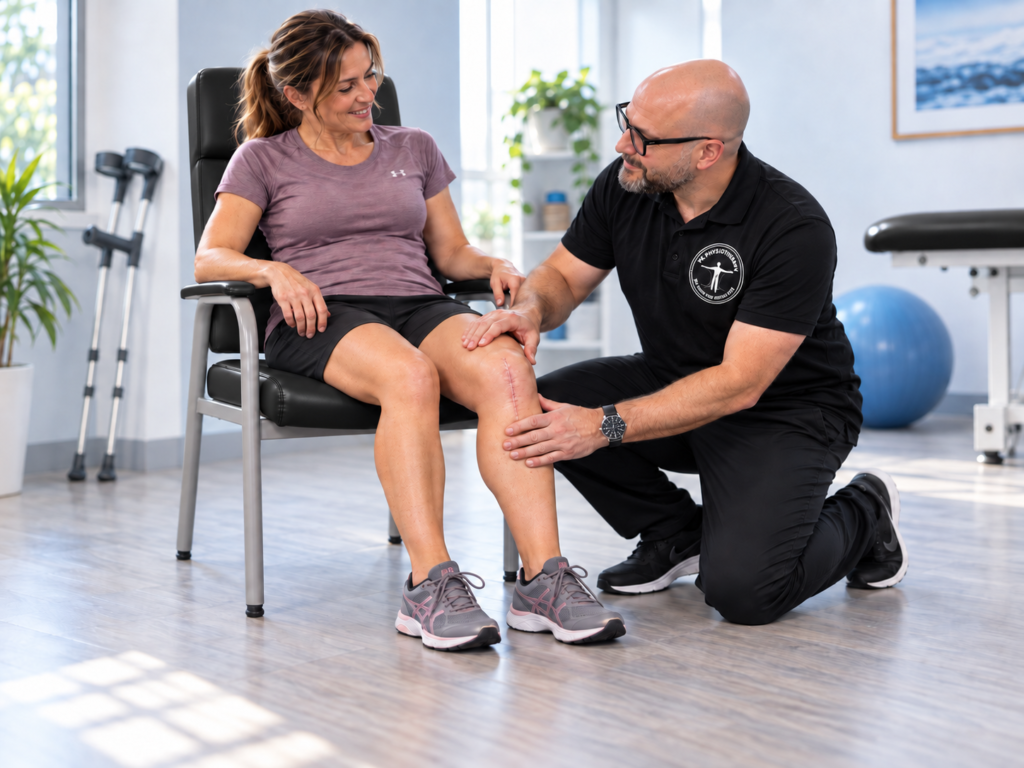
This guide explains what changes inside the knee, presents the published Royal Berkshire NHS rehabilitation programmes for partial replacement first and total replacement second, and shows where arthroscopy fits. The illustrations are simplified educational diagrams. They do not show an individual patient’s anatomy.
The healthy knee and the arthritic knee
The knee brings the thigh bone and shin bone together, with the kneecap at the front. Smooth articular cartilage covers the joint surfaces. Two menisci help spread load between the thigh and shin bones. These are different from the cartilage coating the ends of the bones. The muscles around the knee help control movement. [3]
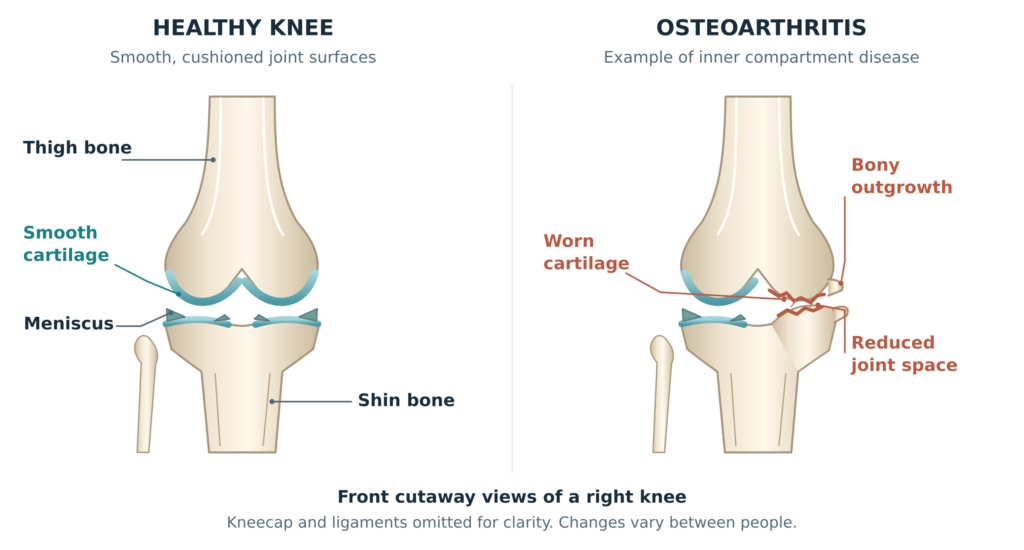
The menisci are shown in cross section. The kneecap and ligaments are omitted.
In osteoarthritis, the cartilage can become thinner and damaged, and bony outgrowths may develop around the joint. Pain, stiffness, swelling and difficulty moving can follow. Symptoms vary considerably. Some people have intermittent discomfort, while others find that walking, sleeping or ordinary tasks become much harder. Osteoarthritis does not always worsen steadily. [2]
When replacement becomes an option
NICE advises considering referral for joint replacement when symptoms substantially affect quality of life and appropriate nonsurgical treatment is ineffective or unsuitable. Exercise, support with weight management when relevant, and suitable pain treatment remain part of care. The decision should take account of your symptoms, function and preferences. An image alone does not decide whether you need surgery. [5]
What partial and total replacement change
A partial knee replacement, also called a unicompartmental knee replacement or UKR, resurfaces one compartment. The example below treats the inner compartment between the thigh and shin bones. Metal components and a plastic bearing replace those damaged surfaces. The remaining compartments are retained. Your surgeon assesses the joint surfaces and ligaments to decide whether this operation is suitable. [3]
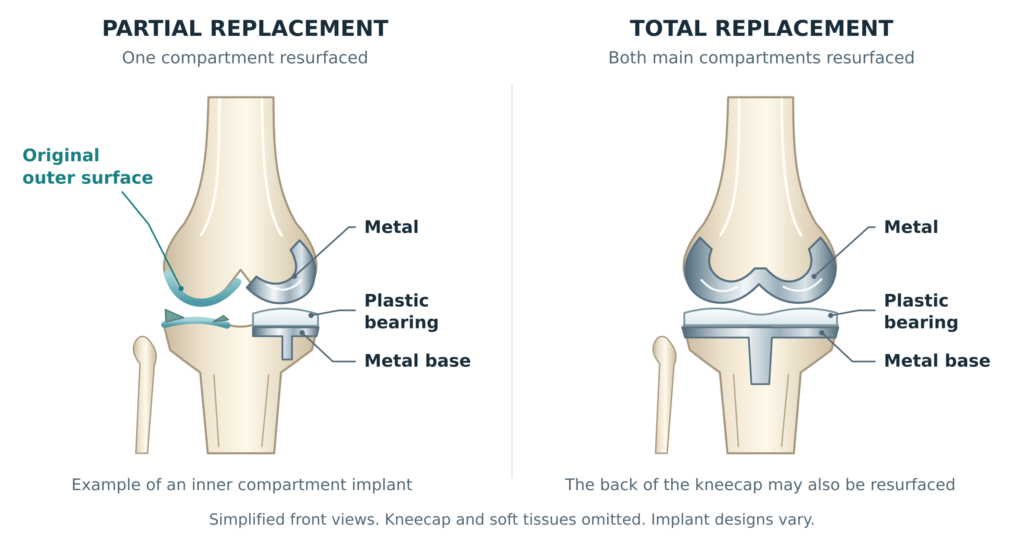
These drawings show the surfaces being resurfaced, rather than a particular manufacturer’s implant.
Figure 2. Partial and total knee replacement compared. These drawings show the surfaces being resurfaced, rather than a particular manufacturer’s implant.
A total knee replacement, or TKR, resurfaces the end of the thigh bone and the top of the shin bone across both main compartments. Metal components form the new surfaces, with a plastic bearing between them. The back of the kneecap may also be resurfaced. Much of your own bone and the muscles around the knee remain. [4]
| Operation | Area treated | What the illustration shows |
| Partial replacement | One compartment | The inner compartment is resurfaced; the outer side remains. |
| Total replacement | Both main compartments | Components extend across the lower femur and upper tibia. |
The partial replacement programme in this article concerns a unicompartmental replacement between the thigh and shin bones. An isolated kneecap compartment replacement, revision operation or additional repair needs its own instructions.
How arthroscopy differs from knee replacement
Arthroscopy is keyhole surgery. A small camera with a light is passed into the joint through an incision, and the surgeon sees the inside of the knee on a screen. Fine instruments can be introduced through other small incisions for a specific procedure. It does not involve fitting the knee replacement components shown on the previous page. Recovery depends on what was actually done inside the joint. [6]
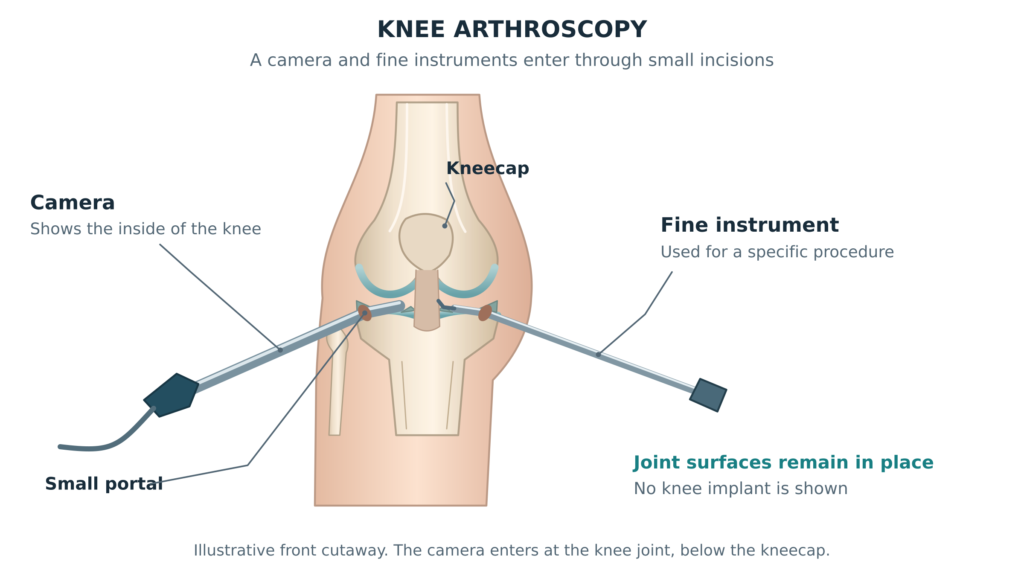
The cutaway is illustrative and is not a surgical instruction.
Arthroscopy does not routinely treat osteoarthritis
NICE advises against arthroscopic lavage or debridement for osteoarthritis. These procedures are sometimes described as washing out or tidying up the joint. They should not be presented as a routine treatment for an arthritic knee or a necessary step before replacement. A separate, specific problem may require a different surgical discussion. [5]
After an arthroscopy, follow the recovery plan for the procedure you had. The replacement programmes on the following pages do not apply automatically to arthroscopic surgery. A small skin incision does not tell you how much healing is needed inside the knee. [6]
Using the NHS programmes
The next two tables are concise summaries of official patient rehabilitation leaflets from Royal Berkshire NHS Foundation Trust. Their stages and numerical exercise doses come from the named documents. Open the linked originals for the full exercise instructions and illustrations. This article is published by PK Physiotherapy and is not an NHS publication or an NHS endorsement.
Use your own surgeon’s restrictions and discharge instructions first. The tables describe recovery after primary knee replacement. They are not an individual prescription, and the time periods are not deadlines. Ask your team to clarify any differences between your discharge sheet and a published leaflet.
Rehabilitation starts in hospital
NICE recommends offering rehabilitation on the day of surgery where possible and no later than 24 hours afterwards. This includes help with mobilisation, daily activities and a home exercise programme. The team should explain how to continue rehabilitation after discharge and how to obtain support if needed. [7]
Before leaving hospital, make sure you know which walking aid to use, how much weight you may put through the operated leg, which exercises to perform, and who to contact. Keep your written instructions available at home and take them to any physiotherapy appointment. [18]
Symptoms that need medical attention
Call 999 if you develop difficulty breathing or chest pain, especially with leg pain or swelling. A blood clot can travel from the leg to the lungs. Do not drive yourself to hospital. [15]
Seek urgent advice from your surgical team, an urgent GP service or NHS 111 for new throbbing or cramping leg pain, fever or shivering, wound discharge, or redness, tenderness, swelling or pain that is worsening. Do not assume these symptoms are simply the result of exercise. [15]
Continue any prescribed anticoagulant medicines and compression stockings for the period your team specifies. Exercises do not replace prescribed blood clot prevention. [15]
Protocol 1: Partial knee replacement
Official source: Royal Berkshire NHS Foundation Trust, October 2025. Review due October 2027. [8]
Exercise dose from the leaflet: start the day after surgery with at least 5 repetitions, once or twice daily. If pain and swelling do not increase, progress to 10 repetitions, 3 or 4 times daily. [8]
| Stage in the leaflet | Main rehabilitation focus |
| Day of surgery | Assisted walking with an appropriate aid; stairs before discharge when required. |
| Up to 2 weeks | Continue taught exercises, concentrating on knee movement. |
| 2 to 3 weeks | Extend short walks. Add supported step exercises when confident. Scar massage only after wound healing. |
| Week 4 | Static bike for 5 to 10 minutes, three times daily. Continue balance exercises. |
| 1 to 3 months | Continue useful exercises and increase repetitions or resistance when appropriate. |
| 3 to 6 months | Build daily activities. Avoid running, jumping and contact sport. |
| 6 months to 1 year | Continue recovery; some joint discomfort may persist. |
Open the complete NHS partial replacement programme
Your own progress matters
A published programme cannot predict the exact day that your knee will be ready for a particular task. If you need the support of crutches for longer, or an exercise is not manageable, discuss this with your treating physiotherapist. South Tees NHS advice emphasises walking well with an aid while you need it. Removing the aid too soon can make walking less safe and less controlled. [14]
Bring the official leaflet together with your own hospital instructions to your review. This allows your physiotherapist to check the intended exercises and the restrictions specific to your operation. Do not add the programmes from several hospitals together to create a larger daily routine.
Protocol 2: Total knee replacement
Official source: Royal Berkshire NHS Foundation Trust, November 2024. Review due November 2026. [9]
Exercise dose from the leaflet: begin the day after surgery with at least 5 repetitions, once or twice daily. Increase to 10 repetitions, 3 or 4 times daily only if pain and swelling do not increase. [9]
| Stage in the leaflet | Main rehabilitation focus |
| Day of surgery | Mobilise with help and an appropriate walking aid. |
| Up to 2 weeks | Continue the hospital exercises for knee movement and muscle activation. |
| 2 to 3 weeks | Gradually extend walking. Add supported step exercises when confident. Scar care follows wound healing. |
| Week 4 | Static bike for 5 to 10 minutes, three times daily; progress balance work. |
| 1 to 3 months | Continue movement exercises. Increase repetitions or add suitable resistance. |
| 3 to 6 months | Build everyday function and suitable hobbies. Avoid high impact and contact sport. |
| 6 months to 1 year | Continue recovery; joint line pain can last longer. |
Open the complete NHS total replacement programme
Why recovery can feel uneven
After surgery, the leg may feel heavy and weak. Pain, bruising, swelling and fatigue can make activity harder even when the new joint is functioning as intended. Take pain relief as prescribed, and ask your GP or surgical team for a review if it is not allowing you to move or exercise comfortably. Keep enough medication available by arranging repeat prescriptions in good time. [14]
Dorset County Hospital explains that swelling and weakness can take months to improve. An area of numb skin beside the scar can also occur and may not fully resolve. Recovery should show an overall improvement. A worsening wound or new calf symptoms need assessment, rather than reassurance based only on how recently the operation took place. [16]
Understanding the early exercises
Your physiotherapist selects the exercises that match your operation and current ability. Follow their dose and any brace restrictions. The drawings below explain familiar movements; they are not an instruction to add every exercise to your hospital programme. [13]
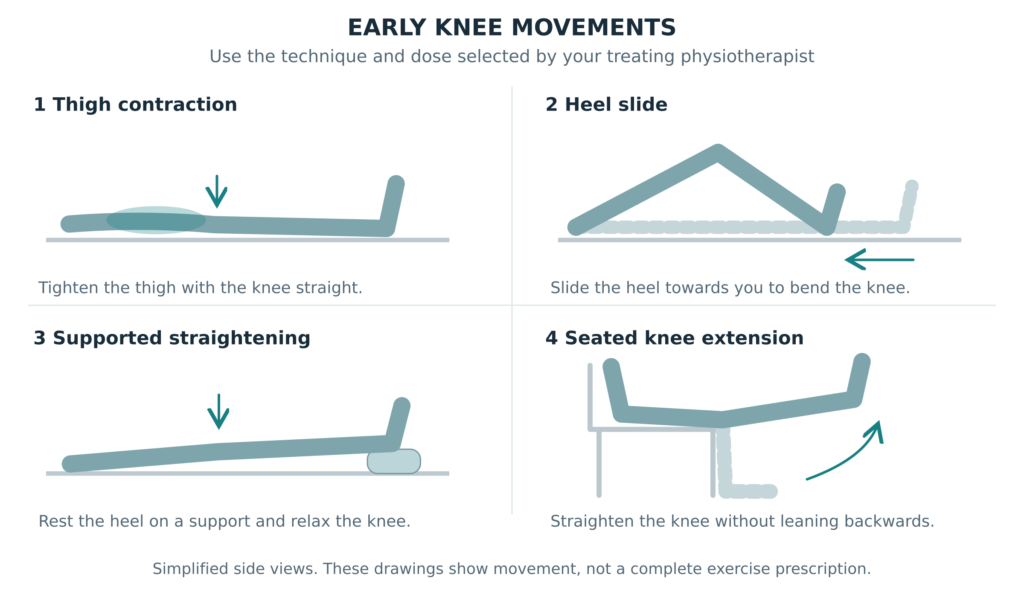
Thigh contraction. With the leg supported and straight, tighten the front of your thigh so that the back of the knee moves gently towards the bed. Relax after the hold you have been taught. [10]
Heel slide. Slide your heel towards your buttock to bend the knee, then straighten the leg again. Keep the movement within a comfortable range. [10]
Supported straightening. Rest your heel on a support and let the knee relax towards straight. Your physiotherapist should show you a suitable position and how long to hold it. [11]
Seated knee extension. Sit with your thigh supported, straighten the knee slowly and lower the foot again. Ankle pumps, performed with the leg still, are another movement commonly taught after surgery. [10]
Building strength and managing daily activity
Progress beyond the first exercises
As your physiotherapist progresses your programme, exercises may include standing up from a chair, supported squats, heel raises, step work and balance practice. The Royal National Orthopaedic Hospital exercise pack is intended for a physiotherapy led class from three weeks after surgery onwards. It advises checking exercise suitability with your therapist or surgeon and increasing difficulty gradually. The advanced exercises shown in that pack are not a checklist that everyone must complete. [12]
The purpose is to build the strength and control needed for your own activities. Discuss the movements you need for work, stairs, shopping or hobbies, so that your physiotherapist can select relevant exercises and progress them with you. Walking, strengthening and balance practice address different aspects of recovery. [12]
Walking and stairs
If you use one crutch or stick, it is generally held on the side opposite the operated knee. Progress away from walking aids with advice from your physiotherapist, once walking is steady and you are no longer limping. [11]
On stairs, use the rail and the technique taught in hospital. Going up, lead with the unoperated leg, bring the operated leg up, then the aid. Going down, place the aid on the lower step first, then the operated leg, followed by the unoperated leg. Begin one step at a time. [11]
Swelling and cooling
When resting, elevate the leg as advised. If your team recommends cooling, protect the skin with a towel and keep the wound dressing dry. Worcestershire’s knee surgery leaflet advises a maximum of 15 minutes per application. Discuss cooling first if you have reduced skin sensation, an infected wound or a condition affecting circulation. Avoid prolonged rest with a pillow holding the knee partly bent. [13]
When a session has been too demanding
Tell your physiotherapist if pain or swelling is preventing the planned exercises, or if walking is becoming less steady. They can review the exercise choice, dose and walking aid. Pain control is part of rehabilitation, so ask your GP or pharmacist for advice if medication is not adequate or is causing problems. New symptoms suggesting infection or a clot require medical assessment. [16]
Returning to everyday life
Driving and work
The national NHS guide advises waiting at least 3 weeks after partial replacement and 6 weeks after total replacement before driving, with medical clearance. These are minimum guides, not permission to drive on that date. Your own hospital may advise longer. Return to work is commonly around 6 to 12 weeks, depending on the job and your recovery.[1]
Before driving, check that you can control the vehicle and perform an emergency stop safely. Follow the surgical team’s advice and your insurer’s requirements. A manual job involving lifting, prolonged standing or repeated stairs may need a longer recovery than desk work. Discuss adjustments or a phased return if necessary. [17]
Swimming, sport and kneeling
Cycling, swimming and golf are common lower impact options. Swimming needs a healed wound and clearance from your team; local timing varies. Discuss running, jumping and contact sports with the surgeon rather than assuming they are safe once walking improves. Kneeling may remain uncomfortable. Wait for clearance, then use a padded surface if appropriate. New clicking can occur after replacement, but clicking with new pain, swelling or instability should be reviewed. [17]
Do you need supervised physiotherapy?
NICE recognises that a home programme can work well for many people when they have clear advice and access to support. Supervised rehabilitation is useful when daily activities remain difficult, specific functional problems need attention, or the home programme is not effective. The amount of supervision should reflect your needs. [19]
How I can help at PK Physiotherapy
At an assessment, I can review your hospital instructions alongside knee movement, walking, muscle control and the activities you want to regain. Bring your discharge letter, exercise sheet and any restrictions from the surgeon. This helps me work with the plan already agreed by your surgical team.
If you are unsure whether to increase an exercise, reduce a walking aid or return to a particular activity, we can assess what is limiting you and agree the next step. Problems with wound healing or symptoms suggesting a medical complication need the appropriate medical team first.
Sources and official NHS programmes
Sources checked on 1 October 2026. The two protocol tables summarise the named Royal Berkshire NHS leaflets. Use the original documents for the complete programme. Other NHS and NICE sources support the explanations and practical advice. Click a source title to open it. No NHS logo or endorsement is implied.
1. NHS. Recovering from a knee replacement
2. NHS. Osteoarthritis
3. Worcestershire Acute Hospitals NHS Trust. Unicompartmental knee replacement
4. NHS. How a knee replacement is done
5. NICE NG226. Osteoarthritis in over 16s diagnosis and management
6. NHS. Arthroscopy
7. NICE NG157. Joint replacement primary hip knee and shoulder
8. Royal Berkshire NHS Foundation Trust. Unicompartmental knee replacement advice and exercises October 2025 Review due October 2027.
9. Royal Berkshire NHS Foundation Trust. Advice and exercises after total knee replacement November 2024 Review due November 2026.
10. United Lincolnshire Hospitals NHS Trust. Total knee replacement exercises
11. Gateshead Health NHS Foundation Trust. Physiotherapy following knee replacement surgery
12. Royal National Orthopaedic Hospital NHS Trust. Total knee replacement exercise pack
13. Worcestershire Acute Hospitals NHS Trust. Exercises after knee surgery
14. South Tees Hospitals NHS Foundation Trust. Post total knee replacement management
15. NHS. Complications of a knee replacement
16. Dorset County Hospital NHS Foundation Trust. Post knee replacement symptom checker
17. Newcastle Hospitals NHS Foundation Trust. Knee replacement surgery
18. NICE QS206. Postoperative rehabilitation advice before discharge