



Piotr Kolodziej | Specialist Physiotherapist | PK Physiotherapy, Northampton
Bell’s Palsy
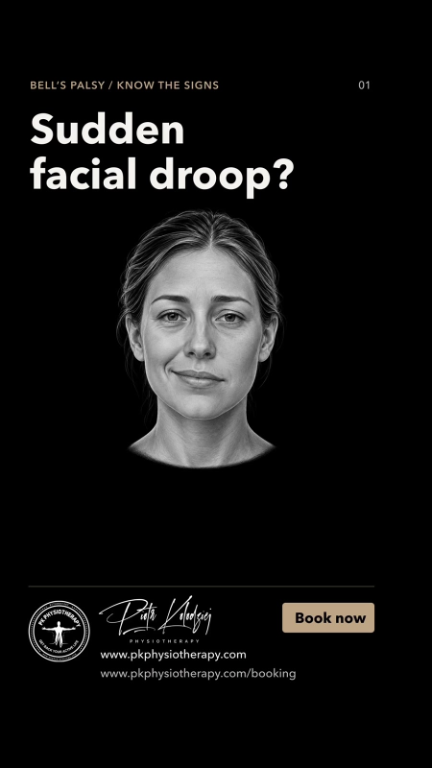
Waking up and suddenly noticing that one side of your face feels weak can be frightening. You may notice that your smile looks uneven, one side of your mouth has dropped, or that you cannot fully close one eye. One possible cause is Bell’s Palsy. The first priority is not exercise. It is prompt medical assessment to confirm the diagnosis and exclude other causes. Once Bell’s Palsy has been diagnosed, carefully selected facial exercises and neuromuscular retraining may form part of rehabilitation.
| Important Sudden facial weakness should never be self diagnosed. Bell’s Palsy can look similar to stroke and other neurological conditions. Medical assessment comes first. |
What Is Bell’s Palsy?
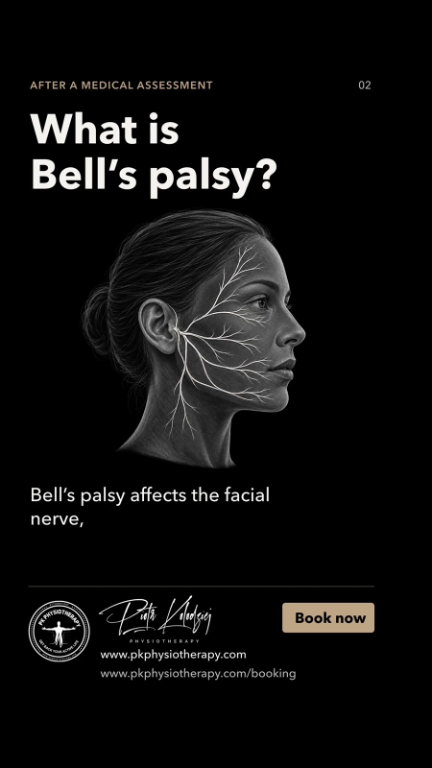
Bell’s Palsy is a sudden weakness or paralysis of the muscles on one side of the face. It is caused by dysfunction of the facial nerve, also called the seventh cranial nerve. Symptoms usually develop over hours or a few days and often appear without warning.
The facial nerve controls many of the muscles used for smiling, blinking and facial expression. It also carries fibres involved in taste, tear production and sensitivity to sound. This is why Bell’s Palsy can produce more than just facial drooping.
Bell’s Palsy is described as idiopathic because there is no single proven cause in most cases. Inflammation and swelling of the facial nerve are thought to play an important role, possibly after viral reactivation in some people.
Common Symptoms
- Sudden weakness or reduced movement on one side of the face
- Drooping of the eyebrow, eyelid or corner of the mouth
- Difficulty smiling normally
- Difficulty closing the eye on the affected side
- Drooling or difficulty keeping food and drink inside the mouth
- Changes in speech because the lips are not moving normally
- Altered or reduced taste
- Dry eye or excessive watering
- Increased sensitivity to sound on the affected side
- Aching or discomfort around the ear or jaw in some people
Is Bell’s Palsy the Same as a Stroke?
No. Bell’s Palsy is a peripheral facial nerve problem, while a stroke affects the brain. The difficulty is that both conditions can cause sudden facial weakness, so the diagnosis should not be made simply by looking in a mirror.
In a typical lower motor neurone facial palsy, weakness affects the forehead as well as the lower face and eye closure. However, this distinction should not be used by a patient to rule out stroke at home. If there are additional neurological symptoms, treat the situation as an emergency.
When Should I Call 999?
Call 999 immediately if facial weakness occurs with any of the following:
- Arm or leg weakness
- New difficulty speaking, slurred speech or difficulty understanding speech
- Confusion
- New visual disturbance
- Sudden loss of balance or severe dizziness
- A sudden severe headache
- Any other new neurological symptoms that make you concerned about stroke
The NHS FAST message remains useful: Face, Arms, Speech, Time. If stroke is possible, do not wait to see whether the face improves.
Why Does Bell’s Palsy Happen?
The exact cause is not fully understood. A common explanation is that inflammation causes swelling of the facial nerve as it travels through a narrow bony canal. Swelling may temporarily interfere with the nerve’s ability to transmit signals to the facial muscles.
Bell’s Palsy has been associated with viral reactivation, including herpes simplex virus. In many people, however, there is no obvious trigger. A person can otherwise feel well and still develop sudden facial weakness.
Who Is More Likely to Develop Bell’s Palsy?
Bell’s Palsy can affect anyone. Research has identified several groups in whom it appears more often, although having one of these factors does not mean that you will develop the condition.
- Pregnancy, particularly during the third trimester and shortly after birth
- Diabetes
- High blood pressure
- Obesity
- A recent upper respiratory or viral illness
Most people experience only one episode, although recurrence can occur. A repeated or unusual episode should still be medically assessed rather than assumed to be Bell’s Palsy.
Medical Assessment and Why the First 72 Hours Matter
If you develop sudden facial weakness, seek an urgent GP appointment, NHS 111 advice or another appropriate medical assessment. This is important both to confirm the diagnosis and to identify whether treatment should start immediately.
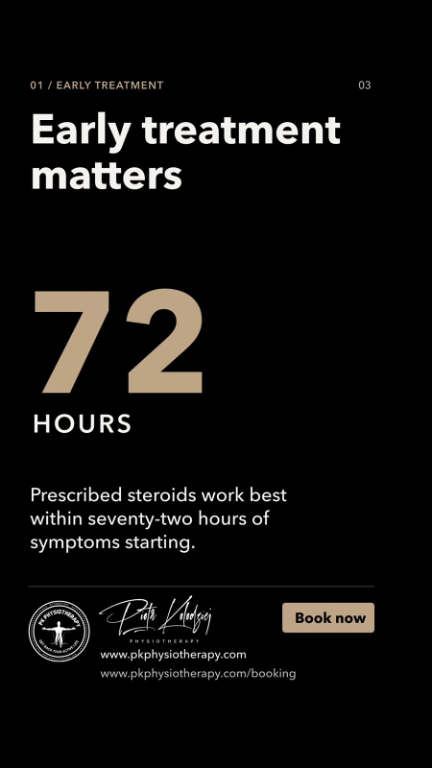
NICE and NHS guidance support oral corticosteroid treatment when appropriate and started within the first 72 hours after symptom onset. Corticosteroids have the strongest evidence for improving the chance of complete recovery. Antiviral medication is not normally used alone and may be considered in selected cases by the treating clinician.
Medical assessment also looks for features that may suggest a different diagnosis, such as Ramsay Hunt syndrome, Lyme disease, ear pathology, recurrent facial palsy, bilateral symptoms or other neurological findings.
What About Antiviral Medication?
Antiviral medicines are not recommended as a stand alone treatment for typical Bell’s Palsy. In selected cases a doctor may prescribe an antiviral alongside corticosteroids, particularly when the palsy is severe or a viral cause such as herpes zoster is being considered.
The evidence for antivirals is less certain than the evidence for corticosteroids, so the decision is medical and individual rather than something every patient automatically needs.
Protecting the Eye
Difficulty closing the eye is one of the most important practical problems in Bell’s Palsy. Normal blinking spreads tears across the eye and protects the cornea. When eyelid closure is incomplete, the surface of the eye can become dry, irritated and vulnerable to injury.
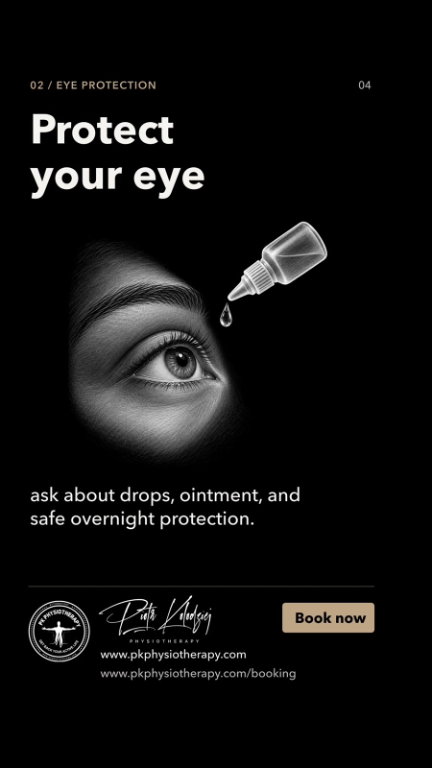
Depending on the degree of eye closure, medical advice may include lubricating eye drops, ointment and safe overnight protection. If the eye is painful, very red, vision changes, or the eye cannot be protected adequately, urgent medical or ophthalmology review may be required.
Will Bell’s Palsy Go Away?
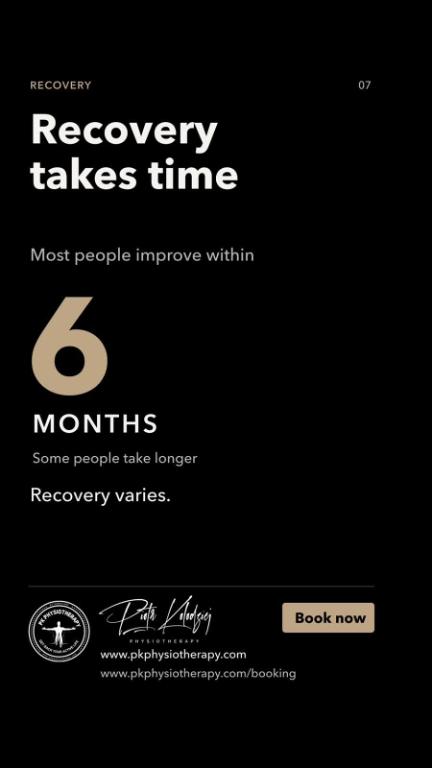
Many people recover well. The NHS advises that most people improve within six months, although recovery can take longer in some cases. The timeline depends on the initial severity of nerve involvement and how the nerve recovers.
Recovery is usually gradual. You may first notice a slightly stronger blink, better lip control, improved symmetry or small movements returning around the mouth. These changes can be more meaningful than repeatedly testing the biggest possible smile.
What Happens During a Physiotherapy Assessment?
At PK Physiotherapy, facial rehabilitation starts only after appropriate medical assessment. The physiotherapy assessment is not simply a check of whether you can smile. It looks at how the face moves at rest and during different expressions, and whether movement is coordinated and symmetrical.
Assessment may include:
- Facial symmetry at rest
- Forehead, eye, cheek and mouth movement
- Quality and control of voluntary movement
- Eye closure and blinking
- Lip control during speech, drinking and eating
- Any tightness, discomfort or altered sensation
- Signs of unwanted linked movement, known as synkinesis
- Functional problems that matter most to you
- Use of a structured facial grading scale where appropriate, such as House Brackmann or Sunnybrook
The aim is to identify the stage of recovery and choose rehabilitation that matches your current presentation rather than giving every patient the same routine.
When Might Further Tests Be Needed?
Bell’s Palsy is usually diagnosed from the history and physical examination. Routine scans or blood tests are not required in every typical new case. Further investigation or specialist referral may be appropriate when the pattern is unusual, weakness develops gradually, both sides of the face are affected, other neurological signs are present, there are painful ear blisters, or recovery is delayed.
Who May Be Involved in Your Care?
Depending on your symptoms, Bell’s Palsy may involve more than one professional. Your GP or urgent care team usually makes the first assessment and starts medical treatment. ENT or neurology may review atypical or persistent cases. Eye care specialists may be needed if the cornea is at risk. Physiotherapy supports facial retraining and recovery, while speech and language therapy may be helpful if speech, swallowing or oral control are significantly affected.
How Can Physiotherapy Help?
Physiotherapy cannot force an injured facial nerve to recover faster. Its role is to support function while the nerve recovers, help you understand what to do and what to avoid, and guide the return of more controlled facial movement.
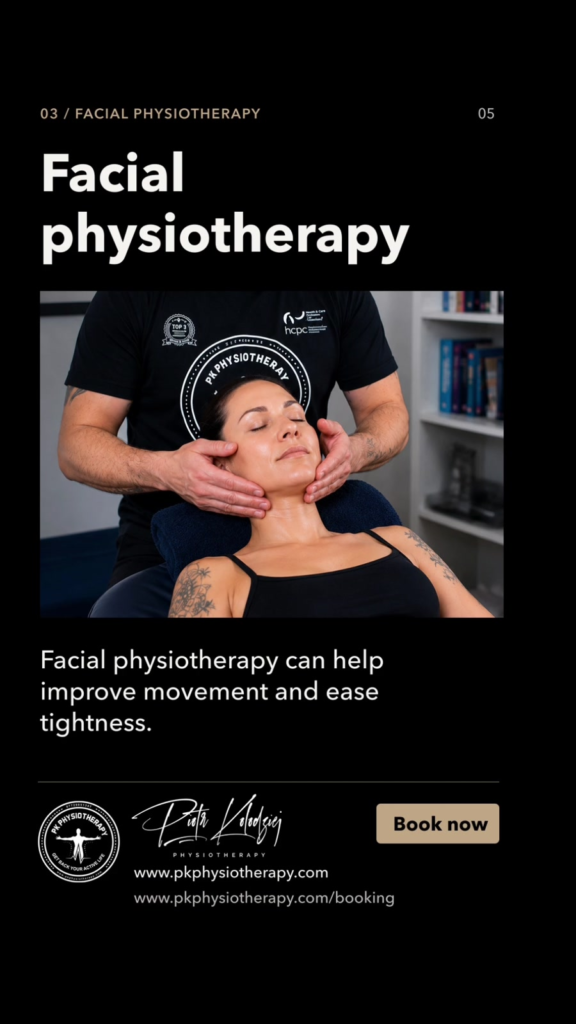
Depending on your presentation, rehabilitation may include education, movement awareness, neuromuscular retraining, mirror feedback, relaxation strategies, gentle soft tissue techniques for comfort or tightness, and an individual home programme.
The emphasis is on movement quality and coordination, not on exercising the face as hard as possible.
Facial Exercises: Gentle, Controlled and Individualised
It is understandable to think that a weak facial muscle should simply be strengthened. Facial palsy is different. The main problem is impaired nerve input and altered coordination, not a muscle that has become weak because it has not been trained in the gym.
As movement starts to return, carefully selected exercises may help with awareness and control. These are usually small, slow and precise. A mirror can sometimes help the patient see unnecessary tension or asymmetry.
Forceful grimacing, repeatedly squeezing the eye shut, stretching the mouth into the largest possible smile, or performing hundreds of repetitions is not the goal. International facial therapy consensus specifically advises against gross facial strengthening as a routine approach.
Six Simple Facial Exercise Examples
These examples show the type of gentle movements that may be used once they are appropriate for your stage of recovery. They are not a universal prescription. The number of repetitions and whether a particular movement is suitable should be based on your assessment and the quality of your movement.
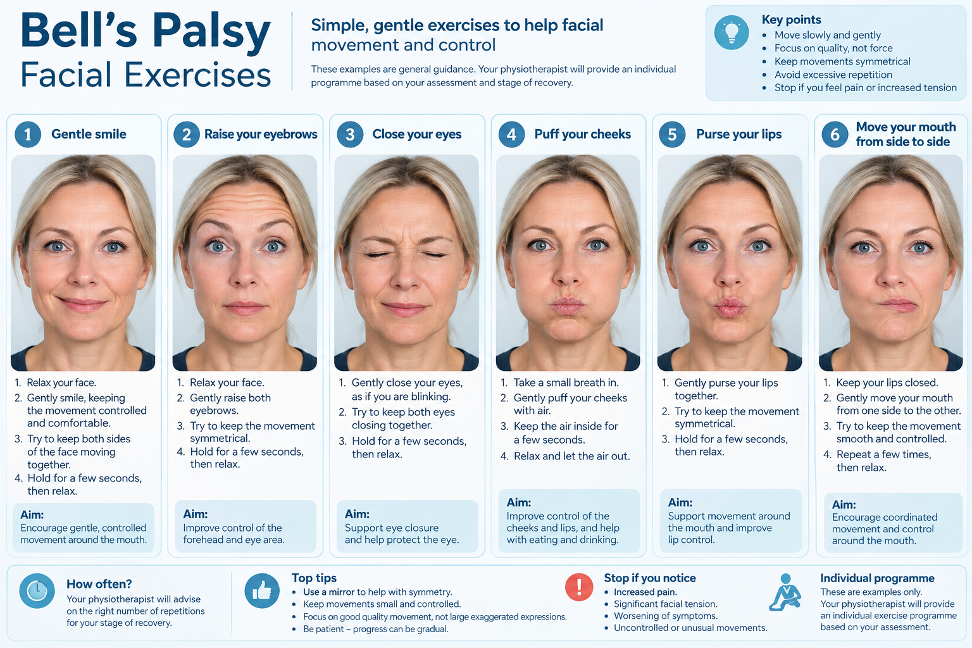
| Important: Do not force a movement that is not yet available. Good facial retraining focuses on small, selective and symmetrical movement. If you develop synkinesis, increasing tightness or unusual linked movements, the programme should be reviewed rather than simply intensified. |
Neuromuscular Retraining and Mirror Feedback
Neuromuscular retraining focuses on relearning more selective facial movement. This may involve practising one movement at a time, reducing unnecessary effort, using visual feedback and learning to relax muscles that are overworking.
This becomes particularly important if synkinesis develops. Synkinesis means an intended movement causes an unwanted movement elsewhere, for example the eye narrowing when smiling or the corner of the mouth moving during eye closure. Rehabilitation aims to improve control rather than simply increase force.
Soft Tissue Techniques and Relaxation
Some people develop a feeling of tightness or stiffness around the cheek, jaw, mouth or neck. Gentle soft tissue techniques may be used as part of a broader programme to improve comfort, awareness and relaxation. They should not be presented as a way of directly repairing or regenerating the facial nerve.
What About Electrical Stimulation?
Electrical stimulation has historically been used in facial palsy, but it remains controversial. The 2024 international facial therapy consensus excluded electrical stimulation from specialist facial therapy recommendations, while supporting education, individualised training and facial neuromuscular retraining. For that reason, routine electrical stimulation is not a core part of the Bell’s Palsy rehabilitation approach described in this article.
Home Exercise Programme
A home programme should be short enough to perform consistently and specific enough to match the current stage of recovery. More repetitions do not automatically produce a better result. Quality matters more than effort.
A programme may include gentle movement practice, relaxation, mirror feedback and functional tasks such as controlled lip movement during speech. It should be reviewed and progressed as the face changes.
What Is Not Routinely Recommended?
More treatment is not automatically better. For a typical new Bell’s Palsy episode, the following are not routinely recommended unless there is a specific clinical reason:
- Antiviral medication used on its own without corticosteroids
- Routine antibiotics when there is no bacterial infection
- Routine imaging or blood tests in an otherwise typical presentation
- Forceful or high repetition facial strengthening
- Routine electrical stimulation as a first line facial rehabilitation treatment
- Surgery for an uncomplicated typical Bell’s Palsy episode
When Should I Seek Medical Review Again?
The NHS advises contacting a GP again if symptoms are not starting to improve after about three weeks. Specialist review may also be appropriate if symptoms worsen, new neurological signs appear, significant eye symptoms develop, the presentation is unusual, or recovery remains incomplete.
Do not assume that a new episode of facial weakness is simply another Bell’s Palsy episode, even if you have had Bell’s Palsy before. New sudden facial weakness still needs medical assessment.
New or worsening neurological symptoms require earlier assessment.
FAQ
Is Bell’s Palsy permanent?
Many people recover substantially or completely, but recovery time and the final outcome vary. A minority of people are left with residual weakness, tightness or synkinesis.
How quickly does Bell’s Palsy develop?
Symptoms usually develop over hours or a few days. Sudden facial weakness still requires prompt medical assessment.
Can Bell’s Palsy affect both sides?
It most commonly affects one side. Bilateral facial weakness is unusual and should be medically assessed.
Is Bell’s Palsy painful?
Weakness is the main feature, although some people experience pain or aching around the ear, jaw or face.
Should I massage my face?
Gentle soft tissue work may sometimes be used for comfort or tightness, but aggressive massage is not necessary and does not directly repair the facial nerve.
Should I keep checking my smile?
Occasional observation is reasonable, but repeated forceful testing throughout the day does not make the nerve recover faster.
When should I see a physiotherapist?
After medical assessment and diagnosis, particularly if you want guidance on safe movement retraining, facial control, symmetry, synkinesis or an individual home programme.
Can physiotherapy cure Bell’s Palsy?
Physiotherapy does not cure the nerve inflammation. Its role is rehabilitation: supporting movement quality, function, confidence and management of residual problems while the nerve recovers.
Bell’s Palsy Rehabilitation at PK Physiotherapy
At PK Physiotherapy in Northampton, I provide one to one assessment and rehabilitation for people who have already been medically assessed and diagnosed with Bell’s Palsy or another peripheral facial palsy.
The programme is based on your current stage of recovery and may include movement assessment, facial neuromuscular retraining, mirror feedback, education, relaxation strategies, appropriate soft tissue techniques and a personalised home programme.
With nearly 30 years of clinical physiotherapy experience, my aim is to give you a clear plan, explain what is happening and help you work on the movements that matter without overworking the face.
References and Further Reading
1. NHS. Bell’s palsy. Patient information and urgent advice. Open source
2. NICE. Suspected neurological conditions: recognition and referral. NG127. Section on unilateral lower motor neurone facial nerve palsy. Open source
3. Madhok VB, Gagyor I, Daly F, et al. Corticosteroids for Bell’s palsy (idiopathic facial paralysis). Cochrane Database of Systematic Reviews. 2016;7:CD001942. DOI 10.1002/14651858.CD001942.pub5. Open source
4. Khan AJ, Szczepura A, Palmer S, et al. Physical therapy for facial nerve paralysis (Bell’s palsy): an updated and extended systematic review of the evidence for facial exercise therapy. Clinical Rehabilitation. 2022;36(11):1424 to 1449. DOI 10.1177/02692155221110727. Open source
5. Nakano H, Fujiwara T, Tsujimoto Y, et al. Physical therapy for peripheral facial palsy: a systematic review and meta analysis. Auris Nasus Larynx. 2024;51(1):154 to 160. DOI 10.1016/j.anl.2023.04.007. Open source
6. Neville C, Beurskens C, Diels J, MacDowell S, Rankin S. Consensus among international facial therapy experts for the management of adults with unilateral facial palsy. Facial Plastic Surgery & Aesthetic Medicine. 2024;26(4):405 to 417. DOI 10.1089/fpsam.2023.0101. Open source
7. Baugh RF, Basura GJ, Ishii LE, et al. Clinical practice guideline: Bell’s palsy. Otolaryngology Head and Neck Surgery. 2013;149(3 Suppl):S1 to S27. DOI 10.1177/0194599813505967. Open source
8. Lee SA, Lee HY, Kwak MY, et al. Clinical Practice Guideline for the Evaluation and Management of Facial Nerve Palsy. Clinical and Experimental Otorhinolaryngology. 2026. DOI 10.21053/ceo.2026-00096. Open source
9. NHS Highland Right Decisions. Bell’s Palsy Guidelines. Reviewed February 2025. Open source
10. Gagyor I, Madhok VB, Daly F, Sullivan F, et al. Antiviral treatment for Bell’s palsy (idiopathic facial paralysis). Cochrane Database of Systematic Reviews. 2019;(9):CD001869.
11. Sullivan FM, Swan IRC, Donnan PT, et al. Early treatment with prednisolone or acyclovir in Bell’s palsy. New England Journal of Medicine. 2007;357(16):1598–1607.
12. Dalrymple SN, Row JH, Gazewood J. Bell palsy: Rapid evidence review. American Family Physician. 2023;107(4):415–420.
Clinical note: This article is for patient education and does not replace individual medical diagnosis or treatment. Sudden facial weakness should be medically assessed promptly.
Back to Bell’s Palsy overview • Back to Assessment • Back to Exercises